

[gtranslate]
MENÜ
⚡ Kurzinfo
Du hast acht Stunden geschlafen, deinen Kaffee getrunken, und schon um 14 Uhr bist du wieder völlig erschöpft. Wenn Erschöpfung zum Normalzustand wird, ist es leicht, dies mit “einfach viel zu tun haben” zu begründen – doch ständige Müdigkeit ist ein Signal, kein Charakterzug. Wird sie lange genug ignoriert, beeinträchtigt sie deine Konzentrationsfähigkeit, deine Stimmung, deinen Stoffwechsel und dein Immunsystem. Dieser Leitfaden beleuchtet 12 versteckte Ursachen für chronische Müdigkeit – und zeigt praktische Lösungen auf, die an der Wurzel ansetzen und dir tatsächlich neue Energie geben.

Normale Müdigkeit hat eine offensichtliche Ursache und lässt sich durch Ruhe beheben – eine lange Nacht, ein hartes Training, eine stressige Woche. Chronische Müdigkeit ist anders:
Wenn Sie unausgeruht aufwachen, jeden Nachmittag einen Energieeinbruch erleben und sich wochenlang “aufgedreht, aber müde” fühlen, liegt wahrscheinlich eine zugrunde liegende Ursache vor – oft sogar mehr als eine. Die gute Nachricht: Die meisten dieser Ursachen lassen sich identifizieren und behandeln, sobald man weiß, worauf man achten muss.
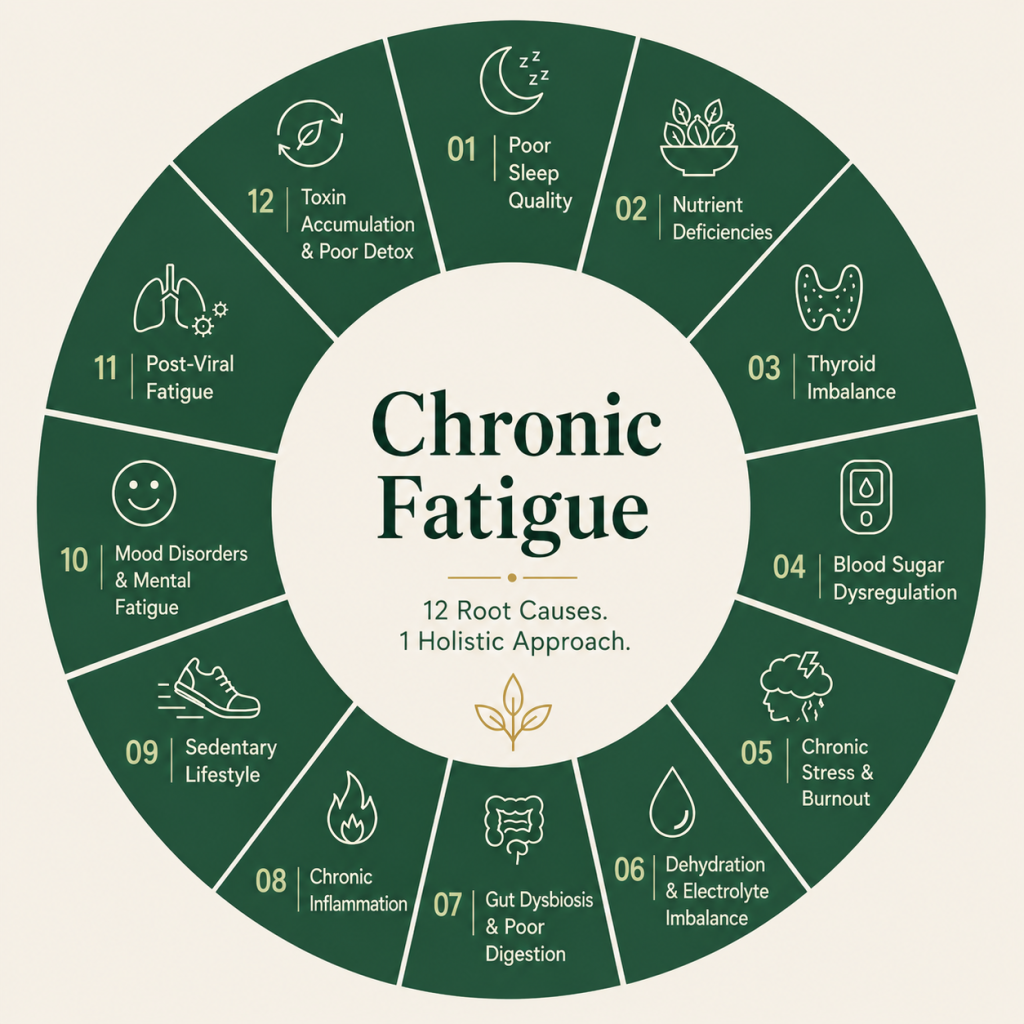
Man kann acht Stunden im Bett verbringen und trotzdem schlecht schlafen. Schlafapnoe, Bildschirmnutzung bis spät in die Nacht, Alkohol und ein unregelmäßiger Tagesrhythmus unterbrechen den Tiefschlaf – jene Phase, in der der Körper sich tatsächlich erholt. Wenn das Einschlafen oder Durchschlafen das Problem ist, helfen diese Natürliche ayurvedische Behandlungsmethoden gegen Schlaflosigkeit und für einen besseren Schlaf die Ursache für schlaflose Nächte bekämpfen, anstatt nur die Symptome zu lindern.
Niedrig Eisen, Vitamin B12, Vitamin D und Magnesium gehören zu den häufigsten – und am häufigsten übersehenen – Ursachen für anhaltende Müdigkeit. Eisenmangel (insbesondere bei menstruierenden Frauen und Vegetariern) führt zu einer Sauerstoffunterversorgung Ihrer Zellen, während ein niedriger Vitamin-B12- und Vitamin-D-Spiegel unbemerkt Ihre Energie und Ihre Stimmung beeinträchtigen.
Eine Unterfunktion der Schilddrüse (Hypothyreose) verlangsamt den gesamten Stoffwechsel und führt zu Müdigkeit, Gewichtszunahme, Kälteempfindlichkeit und geistiger Trägheit. Schilddrüsenprobleme bleiben häufig unerkannt. Da Schilddrüsen- und Blutzuckerprobleme oft Hand in Hand gehen, bietet Tigris Valley Programm zur Behandlung von Stoffwechselstörungen im Zusammenhang mit Schilddrüsenerkrankungen und Diabetes betrachtet diese Einflussfaktoren als ein zusammenhängendes System.
Eine Ernährung mit hohem Zucker- und raffiniertem Kohlenhydratanteil führt den ganzen Tag über zu starken Schwankungen des Energiepegels. Jeder Energieabfall löst eine neue Welle von Müdigkeit und Heißhunger aus. Die Stabilisierung des Blutzuckerspiegels durch ausgewogene Mahlzeiten aus Vollwertkost ist eine der schnellsten Möglichkeiten, um neue Energie zu tanken.
Lang anhaltender Stress sorgt dafür, dass der Cortisolspiegel erhöht bleibt, bis das System schließlich aus dem Gleichgewicht gerät – was dazu führt, dass man erschöpft und ängstlich ist und sich nicht mehr entspannen kann. Dieser “Burnout”-Zustand ist mittlerweile unter Berufstätigen weit verbreitet. Ein spezieller Programm zur Bewältigung von Stress und Burnout in Kerala nutzt Therapien wie Shirodhara, geführte Meditation und das Eintauchen in die Natur, um ein überlastetes Nervensystem wieder ins Gleichgewicht zu bringen.
Schon eine leichte Dehydrierung beeinträchtigt die Aufmerksamkeit und verstärkt das Gefühl der Müdigkeit. Viele Menschen verwechseln Durst mit Müdigkeit und greifen zu Koffein, was die Dehydrierung noch verstärkt. Achten Sie darauf, regelmäßig Wasser zu trinken, noch bevor Sie Durst verspüren.
Ein gestörtes Darmmikrobiom beeinträchtigt die Nährstoffaufnahme und fördert Entzündungen – beides zehrt an der Energie. Im Ayurveda wird ein schwaches Verdauungsfeuer (Agni) wodurch giftige Rückstände entstehen (Ama) gilt als eine der Hauptursachen für Müdigkeit, Antriebslosigkeit und Schweregefühl.
Anhaltende Entzündungen sind stoffwechselmäßig aufwendig – Ihr Körper verbraucht Energie, um ein Feuer zu bekämpfen, das niemals erlischt. Deshalb geht Müdigkeit so oft mit Autoimmun- und Entzündungskrankheiten einher. Das Verständnis der gemeinsame entzündliche Ursachen chronischer Erkrankungen erklärt, warum “ständige Müdigkeit” und chronische Erkrankungen so oft gemeinsam auftreten.
Beide Extreme führen zu Ermüdung. Zu wenig Bewegung lässt den Körper aus der Form geraten und träge werden; zu viel Bewegung ohne Erholung zehrt an ihm. Der ideale Mittelweg ist regelmäßige, moderate Bewegung – Spazierengehen, Yoga und Krafttraining, von denen sich Ihr Körper erholen kann.
Psychische Gesundheit und Energie sind untrennbar miteinander verbunden. Depressionen und Angstzustände sind die Hauptursachen für chronische Erschöpfung und äußern sich oft zunächst in Form von Müdigkeit, noch bevor eine gedrückte Stimmung erkennbar ist. Um dieses Problem direkt anzugehen, durch integrierte emotionale Heilung und Unterstützung im Bereich der psychischen Gesundheit ist oft das fehlende Puzzlestück bei unerklärlicher Erschöpfung.
Nach Infektionen – einschließlich COVID-19 – leiden viele Menschen unter anhaltender Müdigkeit, die Monate andauert. Diese “postvirale” Erschöpfung erfordert eine Stärkung des Immunsystems und eine schrittweise, gemächliche Genesung, anstatt sich einfach durchzubeißen. Ein strukturierter Wiederaufbau des Immunsystems, wie im Paket zur Stärkung des Immunsystems im Tigris-Tal, wurde genau für diese Erholungsphase entwickelt.
Umweltgifte, eine ungesunde Ernährung, Alkohol und eine überlastete Leber führen zu einer Stoffwechselbelastung, die sich in Form von Müdigkeit, geistiger Trägheit und einem Gefühl der Schwere äußert. Wenn die natürlichen Entgiftungswege des Körpers überfordert sind, ist Energie eines der ersten Dinge, die verloren gehen.
Wichtige Erkenntnis: Chronische Müdigkeit ist fast nie auf eine einzige Ursache zurückzuführen. Meistens kommen zwei oder drei dieser Faktoren zusammen – zum Beispiel schlechter Schlaf + Eisenmangel + chronischer Stress. Genau deshalb funktionieren Ratschläge wie “Trink einfach mehr Kaffee” oder “Nimm einfach ein Vitaminpräparat” so selten, während eine ganzheitliche Untersuchung sehr wohl hilft.
Vereinbaren Sie einen Termin für eine fachliche Untersuchung, wenn Ihre Müdigkeit:
Eine über sechs Monate andauernde Müdigkeit ohne erkennbare Ursache kann auf Folgendes hindeuten: Chronisches Erschöpfungssyndrom (ME/CFS) und sollte gründlich abgeklärt werden. Das Ziel ist nicht, Sie zu beunruhigen – sondern sicherzustellen, dass eine behandelbare Ursache nicht übersehen wird.

Da Müdigkeit auf vielfältige Ursachen zurückzuführen ist, setzt eine nachhaltige Erholung an mehreren Fronten gleichzeitig an:
Bei hartnäckigen Fällen werden all diese Aspekte gemeinsam im Rahmen eines stationären, ärztlich betreuten Resets behandelt. Das Tigris Valley’s Paket für Achtsamkeit und geistige Klarheit verbindet die Regeneration des Nervensystems mit Übungen zur Förderung der geistigen Klarheit – hilfreich, wenn geistige Trägheit und mentale Erschöpfung überhandnehmen.
✅ Wichtigste Erkenntnisse
Die Schlafqualität ist genauso wichtig wie die Schlafdauer. Schlafapnoe, Alkohol, Bildschirmnutzung bis spät in die Nacht, Stress oder Nährstoffmangel können den Tiefschlaf unterbrechen, sodass man trotz ausreichender Schlafdauer unausgeruht aufwacht.
Ein Mangel an Eisen, Vitamin B12, Vitamin D und Magnesium tritt am häufigsten auf. Insbesondere Eisenmangel ist eine häufige, leicht zu übersehende Ursache für anhaltende Müdigkeit, vor allem bei Frauen und Vegetariern.
Ja. Chronischer Stress sorgt dafür, dass der Cortisolspiegel erhöht bleibt, bis es zu einer Dysregulation des Systems kommt, wodurch man erschöpft ist, sich “angespannt, aber müde” fühlt und nicht mehr in der Lage ist, sich richtig auszuruhen oder zu erholen.
Nein. Chronische Müdigkeit ist ein Symptom mit vielen möglichen Ursachen. Das chronische Erschöpfungssyndrom (ME/CFS) ist eine spezifische Diagnose für eine unerklärliche, zu einer Behinderung führende Müdigkeit, die länger als sechs Monate anhält und sich bei Anstrengung verschlimmert.
Müdigkeit in Verbindung mit Gewichtszunahme, Kälteempfindlichkeit, trockener Haut, Verstopfung oder geistiger Trägheit kann auf eine Unterfunktion der Schilddrüse hindeuten. Ein einfacher Bluttest (TSH, T3, T4) bestätigt dies.
Auf jeden Fall. Eine Ernährung mit hohem Zucker- und raffiniertem Kohlenhydratanteil führt den ganzen Tag über zu Energiespitzen und -tiefs, während eine unzureichende Nährstoffzufuhr Ihren Zellen das vorenthält, was sie zur Energiegewinnung benötigen.
Eisenverlust durch die Menstruation, Schilddrüsenerkrankungen, hormonelle Veränderungen (PCOS, Perimenopause) sowie eine höhere Häufigkeit bestimmter Autoimmunerkrankungen tragen dazu bei, dass unerklärliche Müdigkeit bei Frauen häufiger auftritt.
Ja. Schon eine leichte Dehydrierung beeinträchtigt die Aufmerksamkeit und verstärkt das Müdigkeitsgefühl. Viele Menschen verwechseln dies mit Hunger oder Schläfrigkeit und greifen zu Koffein, was die Dehydrierung noch verschlimmert.
Ja. Eine schlechte Darmgesundheit beeinträchtigt die Nährstoffaufnahme und fördert Entzündungen – beides raubt Energie. Im Ayurveda gilt eine schwache Verdauung, die zu toxischen Rückständen (Ama) führt, als klassische Ursache für Müdigkeit.
Das ist unterschiedlich – von einigen Wochen bis zu mehreren Monaten. Die Genesung lässt sich am besten durch Stärkung des Immunsystems, dosierte Bewegung, gute Ernährung und Ruhe fördern, anstatt sich einfach durchzubeißen.
Sorgen Sie für ausreichend Schlaf, eine ausreichende Flüssigkeitszufuhr, einen stabilen Blutzuckerspiegel durch vollwertige Mahlzeiten, morgendliche Sonneneinstrahlung und moderate Bewegung. Damit erzielen Sie die schnellsten Erfolge, während die tiefer liegenden Ursachen angegangen werden.
Suchen Sie einen Arzt auf, wenn die Müdigkeit stark ausgeprägt ist, wochenlang anhält, auf eine Infektion folgt oder mit Gewichtsveränderungen, Atemnot, Herzrasen oder anhaltender Niedergeschlagenheit einhergeht.
Hast du es satt, müde zu sein? Finde die wahre Ursache heraus.
Unendliche Mengen an Koffein und der Spruch “Beiß einfach die Zähne zusammen” helfen nicht gegen chronische Müdigkeit. Im Tigris Valley in Kerala führen unsere Ärzte funktionelle Diagnostik durch und erstellen einen individuellen Plan zur Regeneration, der Schlaf, Ernährung, Stressbewältigung, Hormone und Entgiftung umfasst – damit Ihre Energie von Grund auf zurückkehrt.
Dieser Artikel dient allgemeinen Informationszwecken und ersetzt keine individuelle medizinische Beratung. Wenn Sie unter anhaltender oder starker Müdigkeit leiden, suchen Sie bitte einen qualifizierten Arzt auf, um sich angemessen untersuchen zu lassen.

Kaithappoyil, in den Westghats.
Markaz Knowledge City Road, Kaithappoyil, Adivaram, Kerala
Anfahrtsbeschreibung +91 90726 61622 reservation@tigrisvalley.com
Kaithappoyil, Westghats

Bevor Sie gehen
Ein Arzt liest jede Nachricht. Vereinbaren Sie einen Termin oder senden Sie eine Anfrage – Sie erhalten noch am selben Tag eine Antwort.