[gtranslate]
MENU
Germany has more Ayurveda centres than any other European country — from the well-known clinics at Bad Ems to dozens of Heilpraktiker practices offering Panchakarma packages closer to home. So why do so many German wellness travelers still book three-week flights to Kerala instead of a weekend drive to a domestic clinic? The answer isn’t marketing — it’s regulation, clinical depth, and what “Panchakarma” legally and medically means in each country. This guide explains exactly what German Ayurveda centres can and cannot offer, what changes once you land in Kerala, why Germans choose Kerala and why Tigris Valley represents the clinical standard travelers are specifically seeking.
Table of Contents
This is the fact most marketing pages for German Ayurveda centres don’t lead with: Ayurveda is not recognised as a medical system in Germany. It sits in the same regulatory category as other complementary and alternative medicine (CAM) practices — meaning it can legally be offered, but only by individuals holding either a full medical licence (a German MD) or the status of Heilpraktiker — a non-medical practitioner permit unique to the German healthcare system.
This matters enormously for what “Panchakarma” can mean in practice in Germany versus Kerala. In Germany, an Ayurveda clinic operates within a legal framework built for general alternative medicine — not one designed around the specific clinical protocols, physician training, and procedural sequencing that Panchakarma requires as a complete system.
In India, by contrast, Ayurveda holds a legal status equivalent to conventional Western medicine. It is regulated by a dedicated government ministry — AYUSH — with over 750,000 officially registered Ayurvedic physicians and 495 accredited Ayurveda medical colleges nationwide. The institutional infrastructure simply does not have a European equivalent.
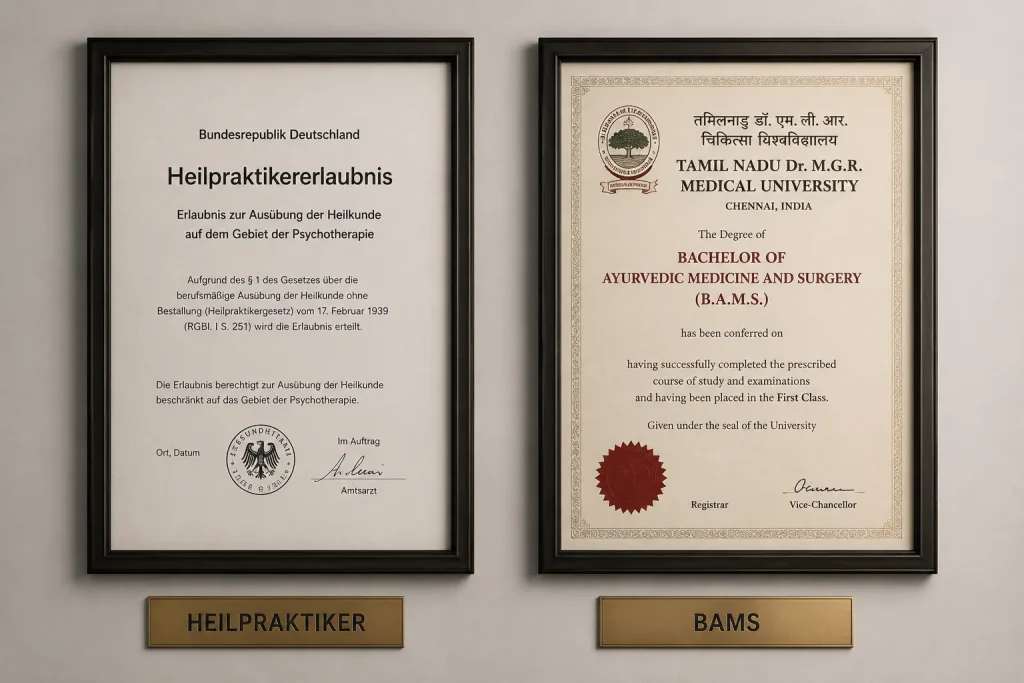
The Heilpraktiker (“healing practitioner”) qualification is the primary legal pathway through which Ayurveda — including Panchakarma — is offered in Germany. Understanding what this credential actually requires is essential for any German traveler comparing domestic options to Kerala.
The Heilpraktiker permit, established under the Heilpraktikergesetz of 1939 and last revised in 2016, does not require any specific Ayurvedic training to obtain. The state exam tests baseline competency in anatomy, pathology, and general diagnostics — not Ayurvedic medicine specifically. An individual can become a licensed Heilpraktiker and then independently decide to specialise in Ayurveda through private coursework of widely varying length and rigour, sometimes as short as several months.
This creates a genuine quality variance problem that German consumers increasingly research before booking. As one German Heilpraktiker school administrator has been quoted describing the situation: practitioners intending to focus purely on Ayurveda are sometimes told a fraction of the full Heilpraktiker training is “enough,” with quality control left to market forces rather than institutional standards.
Key Insight: This is not a criticism of all Heilpraktiker — many are highly competent, ethical practitioners. The point is structural: in Germany, “performs Panchakarma” can describe anyone from a rigorously trained, India-educated specialist to someone who completed a short supplementary course. Without a unified Ayurvedic medical licensing body, German consumers cannot rely on a single credential the way they can rely on NABH accreditation in India.
This is the detail that surprises many German travelers once they research it: a fully qualified Indian Ayurvedic physician — someone who has completed the 5.5-year BAMS (Bachelor of Ayurvedic Medicine and Surgery) degree — cannot register as a medical doctor in Germany using that qualification alone.
German medical licensing does not recognise BAMS as equivalent to a Western medical degree. A BAMS-qualified physician wishing to legally practice Ayurveda in Germany must still pass the Heilpraktiker exam — the same general alternative-medicine credential available to someone with no Ayurvedic training at all — and typically needs strong German language proficiency (B2–C1 level) to do so.
The practical consequence is significant: many of the most rigorously trained Ayurvedic physicians never practice in Germany at all, because the credentialing pathway does not reward or recognise their specific clinical training. The depth of BAMS education — physiology, pathology, pharmacology, and the full Panchakarma clinical curriculum — is simply not part of what determines who can legally perform these procedures in Germany.
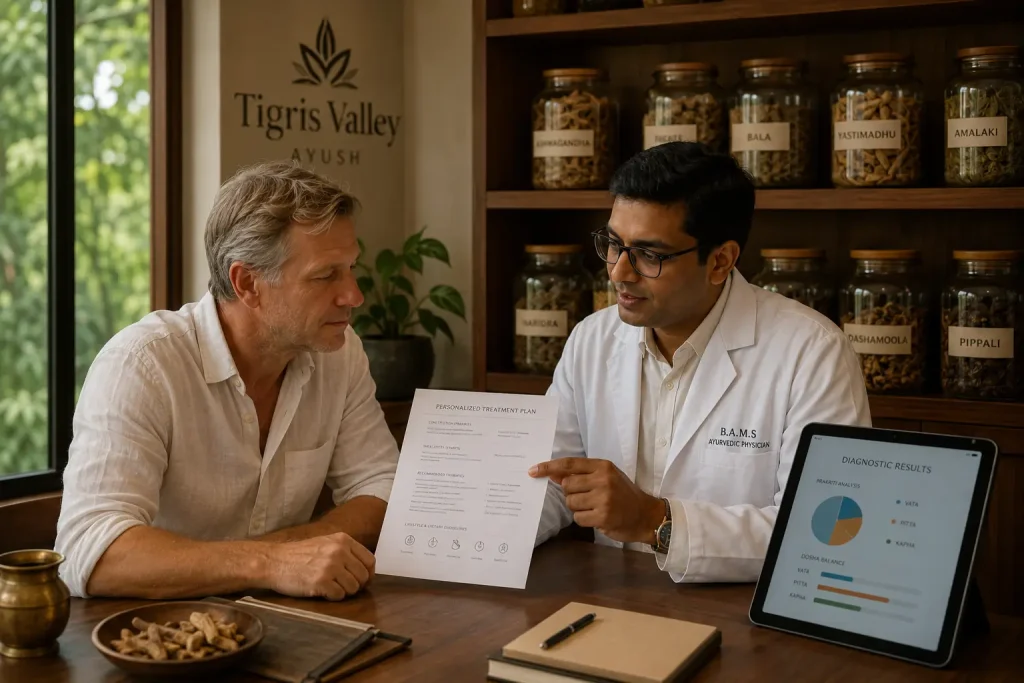
In Kerala, the opposite is true. BAMS is the foundational, government-recognised qualification for Ayurvedic medical practice. Physicians at facilities like Tigris Valley’s Ayurveda department hold this degree as the baseline credential — not an optional specialisation layered onto a general alternative-medicine permit.
An honest comparison requires acknowledging what German Ayurveda centres genuinely offer — because several are reputable, established operations with years of experience, and they are not the strawman some Kerala-focused marketing suggests.
What German centres generally cannot offer — regardless of reputation or years of operation — is BAMS-qualified physicians as the standard of care, NABH-equivalent institutional accreditation specific to Ayurvedic medical practice, or access to the full breadth of fresh, Western Ghats–sourced medicinal herbs at the potency and variety available at source.
For German travelers who have researched both options, several concrete differences become apparent once comparing a German Ayurveda centre against a NABH-accredited Kerala hospital like Tigris Valley:
| Factor | Typical German Ayurveda Centre | Tigris Valley, Kerala |
|---|---|---|
| Legal status of Ayurveda | Unregulated CAM category; practiced under general Heilpraktiker permit | Government-regulated medical system under India’s AYUSH ministry |
| Practitioner qualification baseline | Heilpraktiker exam + variable-length private Ayurveda coursework | 5.5-year BAMS degree as standard physician qualification |
| Institutional accreditation | General wellness/clinic licensing; no Ayurveda-specific accreditation body | NABH-accredited — South Asia’s largest AYUSH-integrated wellness hospital |
| Medicinal plant sourcing | Imported herbs and oils; limited freshness and species variety | Western Ghats biodiversity hotspot; in-house formulations from fresh local herbs |
| Integrative system breadth | Ayurveda as a standalone offering, occasionally with naturopathy | Ayurveda + Unani + Siddha + Yoga & Naturopathy + Acupuncture + Functional Medicine |
| 24/7 medical oversight | Variable; many centres operate on appointment-based therapist availability | Confirmed 24/7 medical assistance as a hospital-level facility |
| Climate during treatment | European climate; channels less naturally receptive per classical Ayurvedic theory | Kerala’s warm, humid climate — classically optimal for Panchakarma absorption |
Cost-consciousness is a well-documented feature of German consumer decision-making, and wellness travel is no exception. The calculation German travelers typically run is not simply “flight cost vs. no flight cost” — it is the full cost of an equivalent depth of treatment.
A comprehensive multi-week Panchakarma program at an established German clinic, priced in euros at German labour, facility, and import-herb costs, typically runs at a significant premium per treatment day compared to an equivalent NABH-accredited program in Kerala — even after adding international flights, visa, and accommodation for the full stay. For a 21-day program, the gap is usually substantial enough that German travelers report the flight cost is effectively absorbed by the difference in daily treatment pricing alone.
This is not a claim that Kerala is “cheap” — Tigris Valley operates as a premium, NABH-accredited facility with corresponding accommodation and care standards. It is a claim about relative value: German travelers frequently find they receive a longer program, broader integrative therapy access, and BAMS-physician-level care, at a comparable or lower total cost than a shorter program at a domestic German centre.
Several consistent priorities define what German wellness travelers research before committing to an international Ayurveda program:
Key Insight: Germany’s own “Kur” tradition — structured, multi-week therapeutic retreats historically covered in part by German health insurance for specific conditions — created a cultural readiness for exactly the kind of immersive, residential healing program Panchakarma represents. This cultural overlap is part of why German interest in authentic Kerala Ayurveda has remained consistently strong even as domestic German Ayurveda options have multiplied.
Tigris Valley — confirmed as South Asia’s largest AYUSH-integrated, NABH-accredited wellness hospital — represents what the regulatory gap described above looks like when fully closed. For German travelers, the practical features that matter most:
Explore the complete range of wellness programs, review the full AYUSH treatment portfolio, and check the travel guide from Europe to begin planning.
No. Ayurveda is legal in Germany when practiced by a licensed medical doctor or a registered Heilpraktiker. It is not, however, recognised as an independent medical system with its own dedicated regulatory and licensing framework — unlike in India, where it is governed by the AYUSH ministry with parity to conventional medicine.
Yes, within the scope of their Heilpraktiker permit, practitioners can offer Panchakarma-style procedures including Basti and Virechanam. The variable factor is the depth and rigour of the practitioner’s specific Ayurvedic training, since the Heilpraktiker exam itself does not test Ayurvedic competency — that knowledge typically comes from separate, non-standardised coursework.
Coverage varies significantly by insurer and policy, and is generally limited since Ayurveda is not a recognised conventional medical system in Germany. Some supplementary private insurance plans offer partial CAM coverage. This is a question best directed to your specific insurer, as it falls outside what either German Ayurveda centres or Tigris Valley can determine on your behalf.
A BAMS degree represents 5.5 years of dedicated Ayurvedic medical education covering physiology, pathology, pharmacology, and clinical Panchakarma training within India’s regulated medical system. A Heilpraktiker’s Ayurveda-specific training varies widely in depth and is not standardised. For the specific clinical depth of Panchakarma, the BAMS pathway represents a more rigorous and consistent qualification standard.
Convenience, native-language consultation, no long-haul travel requirement, and — for some established German centres — genuine decades of accumulated clinical experience are legitimate reasons. The choice depends on whether a traveler prioritises proximity and language comfort, or the regulatory depth, herb freshness, and BAMS-physician standard available in Kerala.
Program durations of 7, 14, and 21 days are available. German travelers — drawing on the cultural familiarity of the multi-week “Kur” tradition — frequently choose 14 or 21-day programs, particularly for chronic conditions or comprehensive Panchakarma cycles.
Tigris Valley’s primary consultation and medical language is English. German guests should confirm current German-language support availability directly with the reservations team when booking, as interpreter or translated-material support can be arranged depending on staffing at the time of your visit.
Tigris Valley is located in Wayanad, in the Western Ghats mountains, where elevation moderates temperatures significantly compared to coastal Kerala — typically 5–8°C cooler. Most German guests find the climate very manageable, particularly outside the hottest pre-monsoon months (March–May).
Yes. NABH accreditation status can be independently verified through the National Accreditation Board for Hospitals and Healthcare Providers. When contacting Tigris Valley, you can request the specific accreditation reference for your own verification — a step in line with the research-intensive approach typical of German wellness travelers.
Contact the reservations team at reservation@tigrisvalley.com or call/WhatsApp +91 9072661622. The first step is a pre-arrival medical consultation to review your health history and design a personalised program before you travel.
Experience Ayurveda at Its Clinical Source
BAMS-qualified physicians. NABH accreditation. Fresh Western Ghats herbs. 24/7 medical oversight. The standard German wellness travelers research for — and find — at Tigris Valley.