[gtranslate]
MENU
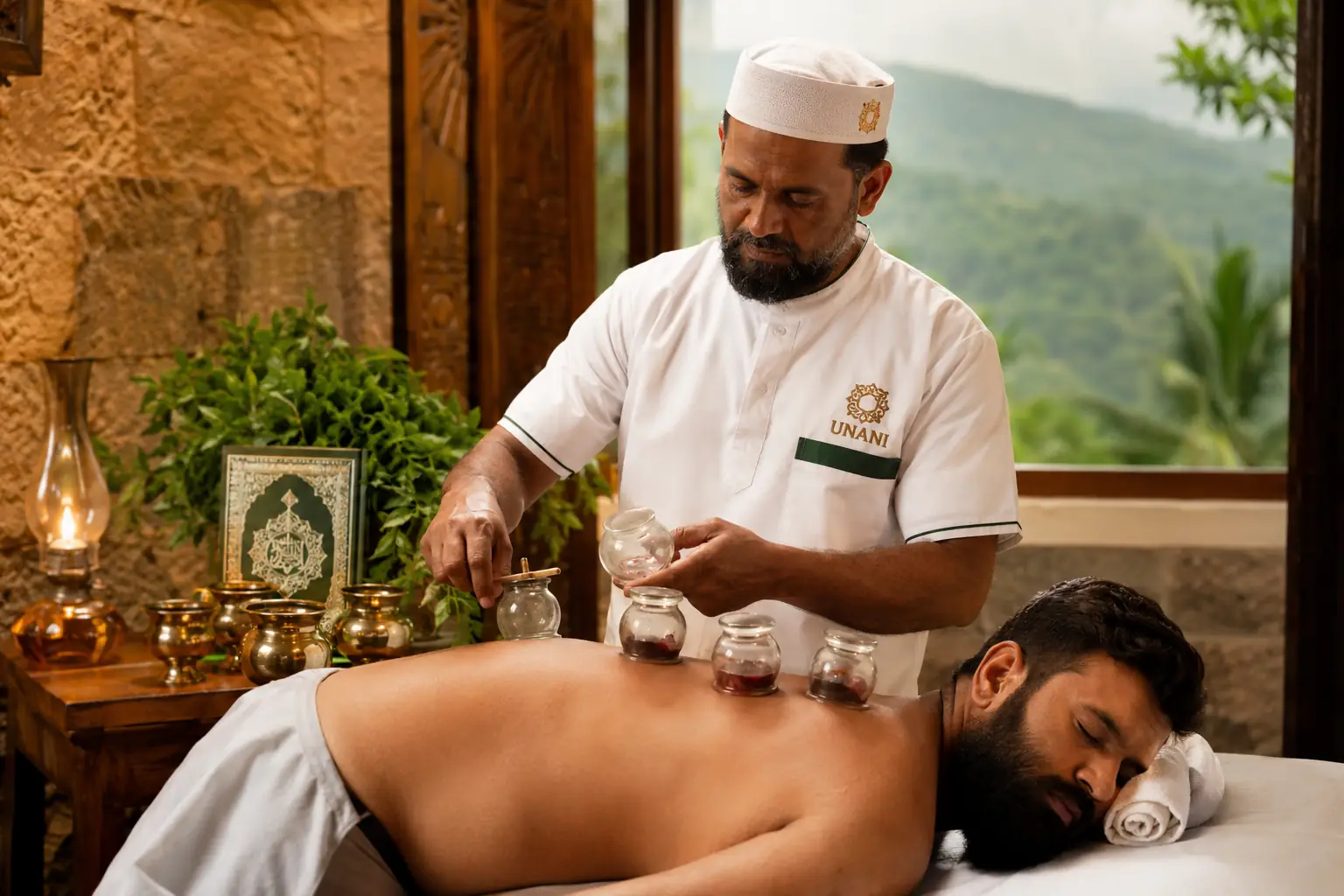
Millions of Muslims turn to Hijama in Islam as a Prophetic Sunnah — only to find it offered at unregulated parlours with no medical oversight, or dismissed entirely by conventional healthcare. The result: a sacred healing tradition either practiced without clinical safety or abandoned altogether. At Tigris Valley, we’ve built something different — a medically supervised environment where Hijama is integrated with modern Unani and Functional Medicine, honouring both the Sunnah and your safety simultaneously.
📋 Table of Contents
Hijama — from the Arabic root hajama, meaning “to diminish” or “to restore to a healthy state” — is the therapeutic practice of wet cupping described in authentic Hadith literature as a Prophetic Sunnah. The Prophet Muhammad (ﷺ) is reported to have said:
“The best of remedies you have is Hijama (cupping), and if there was something excellent to be used as a remedy then it is Hijama (cupping).”
— Sahih al-Bukhari 5371, Sahih Muslim 2952
This is not a peripheral tradition. The authentic Hadith corpus contains multiple references to Hijama — describing specific points on the body, recommended days of the month (17th, 19th, and 21st of the Islamic lunar calendar are most frequently cited), and specific conditions for which it was recommended or performed. For believing Muslims, this elevates Hijama from a wellness technique to an act of itba’ (following the Prophetic example) — simultaneously a spiritual practice and a healing therapy.
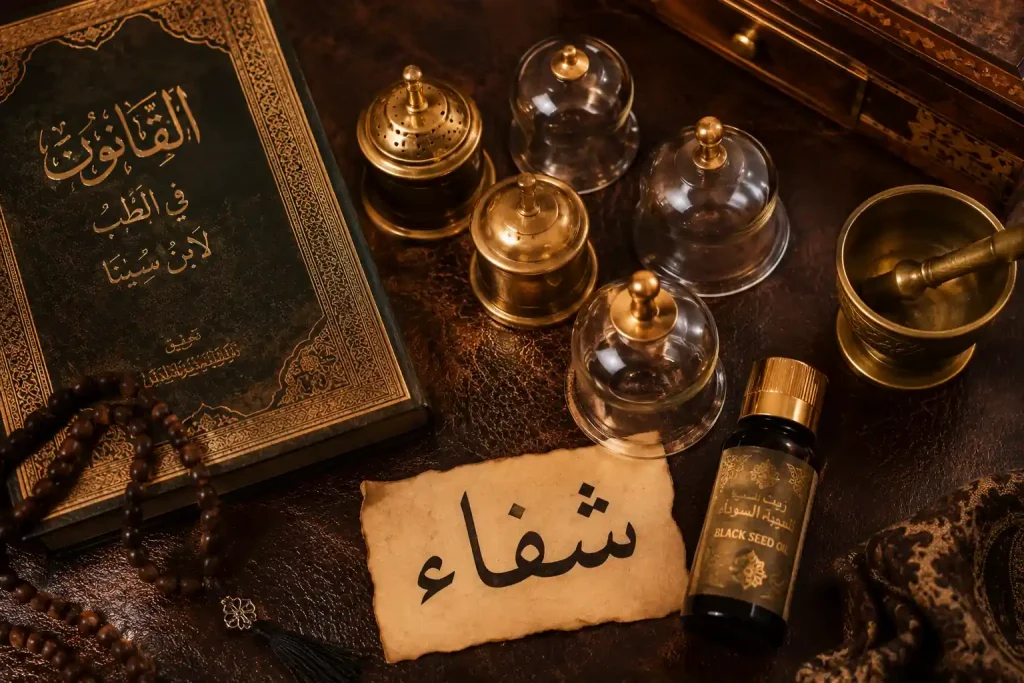
Historically, Hijama has been central to Unani medicine — the classical Islamic medical system that synthesised the Prophetic healing tradition with the Greco-Arabic corpus of Hippocrates, Galen, and Ibn Sina (Avicenna). The term fasd (bloodletting, of which wet cupping is a form) appears throughout Ibn Sina’s Canon of Medicine with detailed clinical indications, contraindications, and seasonal recommendations that align closely with the Prophetic Hadith guidance.
A common source of confusion — even among those familiar with Hijama in Islam — is the distinction between dry cupping and wet cupping (Hijama proper). These are mechanically related but clinically distinct procedures:
| Feature | Dry Cupping | Wet Cupping (Hijama) |
|---|---|---|
| Mechanism | Suction applied to skin surface using cups; no incision | Suction applied first, then small superficial incisions made to draw out stagnant blood and morbidities |
| Blood removal | No | Yes — small, controlled quantities of stagnant superficial blood |
| Primary action | Improves local circulation, relieves muscle tension, stimulates lymph flow | Removes morbidities (Unani: fasid akhlat); reduces systemic inflammatory load; restores humoral balance |
| Sunnah status | Not specifically mentioned in Hadith literature | Specifically referenced in multiple authenticated Hadith |
| Medical supervision | Generally lower-risk; wide availability | Clinical setting strongly recommended; requires assessment for contraindications |
| At Tigris Valley | Available as complementary therapy | Offered under physician-supervised Unani medicine protocol as Hijama therapy |
Key distinction for faith-based seekers: The Sunnah practice referenced in authenticated Hadith is specifically wet cupping — Hijama proper — not dry cupping. At Tigris Valley, it is the wet cupping protocol, administered under Unani physician supervision, that honours this tradition within a clinically safe framework.
The Prophetic tradition specifies several anatomical locations where Hijama was performed or recommended. These correspond closely to classical Unani medicine’s therapeutic point system and have notable overlap with acupuncture meridian points — a convergence that modern integrative medicine researchers find increasingly significant.
Classical Unani physicians — building on the Prophetic foundation — developed an extended system of cupping points based on the humoral theory of disease. Additional points are selected by the Unani practitioner based on individual assessment of the patient’s temperament (mizaj), presenting condition, and the location of humoral excess. At Tigris Valley, your practitioner will identify these during the initial consultation.
Clinical Note: Hijama points selected at Tigris Valley are determined through physician assessment combining Unani temperament analysis and the patient’s clinical presentation — not selected from a fixed pre-printed chart. This personalised approach aligns with both the Prophetic guidance (which addressed specific individuals for specific conditions) and modern clinical best practice.
This is the question that bridges faith and science — and it deserves a straightforward, evidence-honest answer rather than either uncritical endorsement or dismissal.
The peer-reviewed literature on cupping therapy — including wet cupping — has grown substantially in recent decades. Research published in journals including PLOS ONE, the Journal of Traditional and Complementary Medicine, and the Evidence-Based Complementary and Alternative Medicine journal points to several consistently documented physiological mechanisms:
Important Caveat: The quality and sample size of individual cupping studies varies considerably. Tigris Valley presents this evidence transparently — as a growing but not fully conclusive body of research supporting physiological mechanisms consistent with the therapeutic effects observed clinically. We do not make claims beyond what the evidence supports.
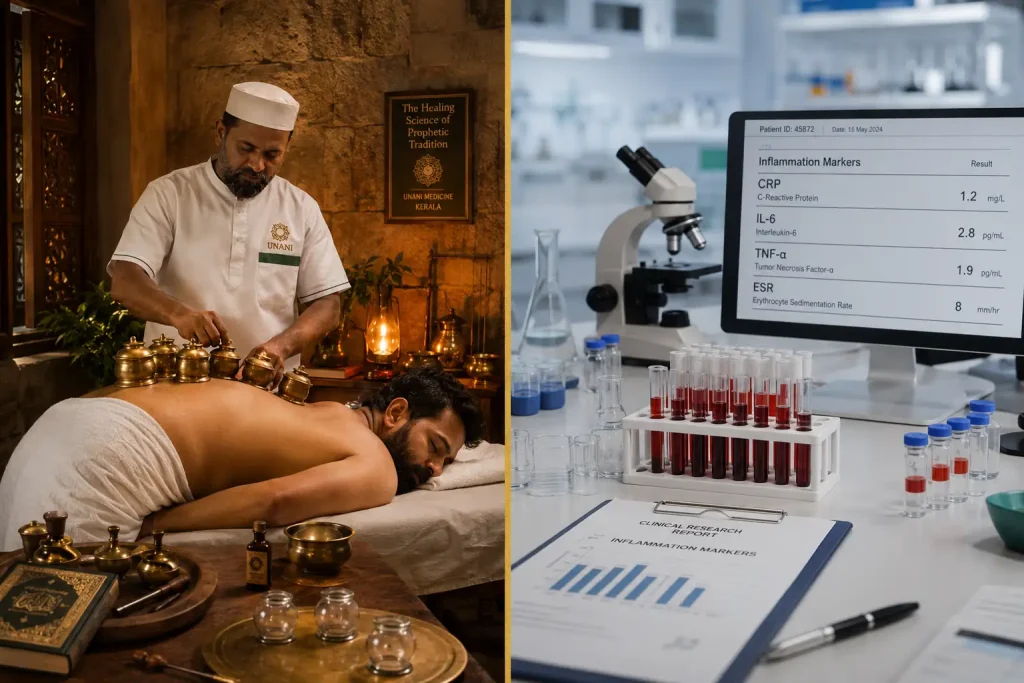
The following benefits are drawn from the combination of Unani medical tradition, peer-reviewed clinical evidence, and the clinical observations of the Hijama therapy program at Tigris Valley:
In Unani medicine’s humoral framework, many chronic conditions arise from the stagnation and corruption of blood and other humours. Hijama’s wet cupping mechanism physically removes a small quantity of superficial blood — including the degraded cells, inflammatory mediators, and metabolic waste products that accumulate in areas of chronic inflammation or poor circulation.
Hijama is one of the most consistent clinical applications across both the Prophetic tradition and modern research. Pain conditions including back pain, neck pain, migraines, joint pain, and fibromyalgia-like syndromes are specifically addressed by the Chronic Pain & Inflammation Management Program, where Hijama is integrated as a key Unani modality.
Multiple studies have measured reductions in inflammatory biomarkers following Hijama sessions. For patients managing autoimmune-related inflammation — a growing cohort seeking the Autoimmune Disorder Management Program — this anti-inflammatory mechanism is particularly clinically relevant.
The suction mechanism of Hijama creates powerful local vasodilation, improving blood flow to areas of chronic circulatory stasis. This is relevant to cardiovascular risk management and is integrated within the Cardio-Metabolic Health & Recovery Program at Tigris Valley.
Within the Detox & Cleanse Program, Hijama complements Panchakarma detoxification by removing morbidities through the skin — an elimination pathway that operates in parallel to the digestive and lymphatic routes targeted by Virechanam and Basti.
Within Tigris Valley’s Stress & Burnout Recovery Program, wet cupping (Hijama) is specifically mentioned as a Unani healing modality for detoxification and energy flow improvement — supporting the autonomic nervous system regulation that underpins recovery from chronic stress and burnout.
The localised immune stimulation from Hijama’s controlled micro-injury is being studied as a potential mechanism for broader immune modulation. For guests exploring the Immune Strengthening Package, Hijama’s immune-activating effect provides a faith-aligned and physiologically grounded addition to the program.
This is where Tigris Valley’s approach differs meaningfully from standalone Hijama parlours or faith-healing-only settings. The integration model has four components:
Every guest who undergoes Hijama at Tigris Valley first completes a physician consultation covering health history, current medications, blood profile, coagulation status, and existing conditions. This is not optional protocol — it is the standard of care that identifies contraindications and tailors the treatment to the individual.
The selection of Hijama points, cupping duration, quantity of blood removed, and frequency of sessions is determined by a qualified Unani medicine practitioner — not a generic chart or standardised package. This reflects both the Prophetic tradition (which addressed specific individuals in specific conditions) and modern personalised medicine principles.
At Tigris Valley, Hijama does not operate in isolation. It is coordinated with:
As a NABH-accredited wellness hospital, Tigris Valley maintains 24/7 medical support — meaning any post-procedure question or response is managed within a clinical oversight framework, not left to the guest to navigate independently after leaving a standalone therapy centre.
Clinical honesty requires clearly stating both groups:
This is precisely why Tigris Valley’s pre-session physician consultation is not a formality. Hijama’s contraindications are real, and the clinical assessment that identifies them is what separates a safe, beneficial session from a risky one. Guests with any of the conditions above should discuss their status fully during the pre-arrival consultation rather than booking Hijama independently.
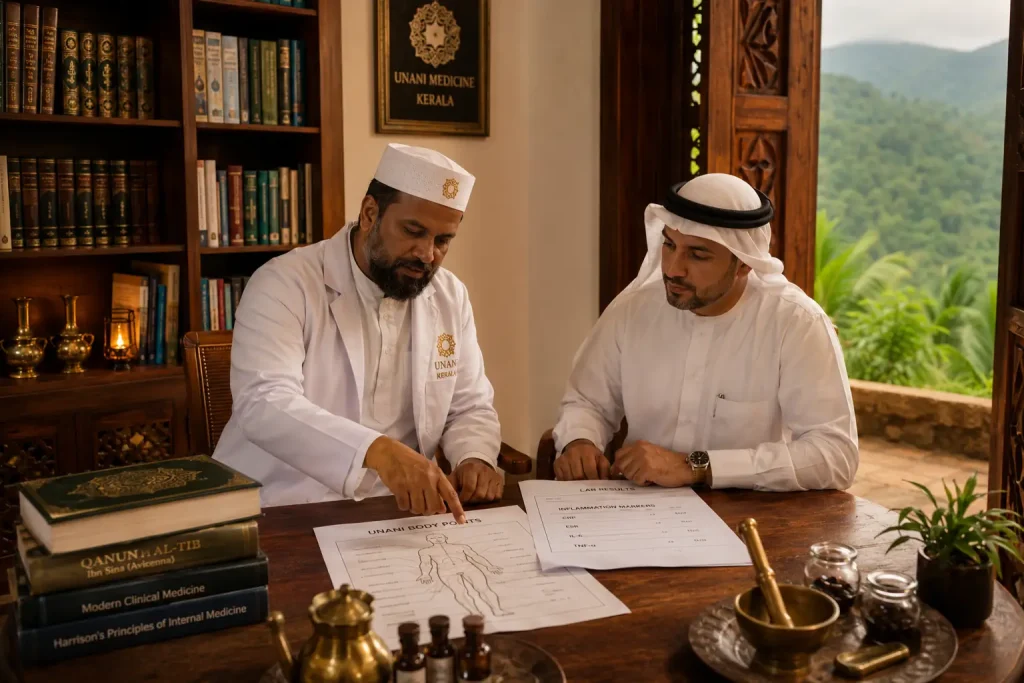
Understanding where Hijama fits institutionally at Tigris Valley requires understanding Unani medicine — the system within which it is clinically administered.
Unani medicine (Tibb-e-Unani) is the classical Islamic medical tradition, systematised by Ibn Sina (Avicenna) in the 11th century and developed across the Islamic Golden Age by scholars including Al-Razi (Rhazes) and Al-Zahrawi. It synthesises the Prophetic healing tradition with the Hippocratic and Galenic corpus, filtered through Islamic scholarship and clinical refinement across centuries.
In India’s AYUSH system, Unani holds one of the five recognised traditional medical systems alongside Ayurveda, Yoga, Siddha, and Homeopathy — regulated, taught at accredited colleges, and practiced by government-registered Unani physicians (holding the BUMS degree — Bachelor of Unani Medicine and Surgery).
This institutional context matters for Muslim guests specifically: Hijama at Tigris Valley is administered by practitioners with formal Unani medicine training within India’s regulated AYUSH framework — not informally by therapists with supplementary cupping certificates. It is the clinical home the practice deserves.
Explore the full Unani Medicine treatments at Tigris Valley, which include Hijama, customised herbal formulations, and Unani dietary management alongside Ayurveda and modern Functional Medicine.
For first-time guests, clarity about the procedure reduces anxiety and improves the therapeutic experience. Here is what a physician-supervised Hijama session at Tigris Valley involves:
| Stage | What Happens | Duration |
|---|---|---|
| Pre-session consultation | Physician reviews your health profile, selects cupping points, confirms no contraindications, and discusses the session | 15–20 minutes |
| Positioning & preparation | You lie comfortably in the treatment room; the skin at cupping sites is cleaned with sterile preparation | 5 minutes |
| Dry cup placement | Cups are placed over the selected points using suction; you feel a drawing, pulling sensation — not pain. The skin rises into the cup, appearing darkened red or purple at the site. | 3–5 minutes |
| Superficial incisions | Cups are removed; a sterile lancet makes very small, shallow incisions at the cupping site — typically felt as mild pressure rather than pain at this stage | 1–2 minutes |
| Second cup placement | Cups are re-applied over the incision sites; dark, stagnant blood is drawn out into the cup. The drawing sensation is present; most guests describe it as mild and tolerable | 5–10 minutes |
| Cup removal & wound care | Cups removed; incision sites cleaned, treated with antiseptic, and covered with sterile dressings | 5 minutes |
| Post-session rest & monitoring | You rest for 20–30 minutes; hydration provided; physician checks your response before you leave the treatment area. Light fatigue is normal and expected. | 20–30 minutes |
Total session time: approximately 60–75 minutes. The incision sites typically heal within 3–5 days. Minor bruising or skin marks at cupping sites are normal and resolve within days to a week.
Yes. Multiple authenticated Hadith in Sahih al-Bukhari and Sahih Muslim describe the Prophet (ﷺ) recommending, undergoing, and praising Hijama (wet cupping). Islamic scholars from across the major madhabs (legal schools) have classified Hijama as a confirmed Sunnah practice, with the additional dimension of being an act of faith when performed with the intention of following Prophetic guidance.
Hadith literature cites the 17th, 19th, and 21st of the Islamic lunar month (corresponding to the middle third of the month when the moon is full or waning) as the most beneficial days for Hijama. This recommendation is rooted in the physiological observation — also supported by early Unani medicine — that blood is more superficial and circulatory activity is higher during the full moon phase. Tigris Valley’s team can assist with scheduling that honours this recommendation where possible.
Most guests describe the sensation during Hijama as a strong pulling or drawing feeling during cup placement, and mild pressure during the incision phase — not acute pain. The incisions are very superficial — significantly shallower than a standard blood draw needle insertion. The intensity of the sensation varies by individual sensitivity and the anatomical site. Most guests report that anticipation is worse than the actual experience.
Frequency depends on the individual’s health condition, constitution, and therapeutic objective. As a general Sunnah wellness practice for healthy individuals, Hadith guidance and classical Unani medicine suggest twice yearly — commonly in spring and autumn. For specific therapeutic conditions, your Unani physician at Tigris Valley will recommend an appropriate frequency based on your clinical assessment.
Certain medications — particularly anticoagulants (blood thinners) — interact with wet cupping’s blood removal mechanism and must be disclosed during the pre-session physician consultation. This is why Tigris Valley’s physician-supervised approach is essential: the practitioner reviews your medication list and determines whether Hijama is safe, needs modification, or should be temporarily deferred. Never undergo Hijama at an unmonitored centre while on anticoagulant therapy.
Emerging research and classical Unani medicine both suggest that Hijama may support blood pressure regulation through its effects on circulatory dynamics and inflammatory load. Guests managing hypertension should discuss this with Tigris Valley’s physician team, as Hijama would be integrated within a broader Cardio-Metabolic protocol rather than used as a standalone intervention.
There is a difference of opinion among Islamic scholars on whether Hijama breaks the fast — some hold that it does (based on specific Hadith), while others from the Maliki and Shafi’i traditions hold that it does not. Tigris Valley respects this diversity of scholarly opinion and leaves the timing decision to the individual and their religious advisor. Practically, guests often schedule Hijama for after Iftar or during non-fasting days.
Both are Unani therapeutic bloodletting methods. Fasd (venesection) involves opening a vein directly to remove blood — a more intensive procedure used for conditions involving excess blood in the deeper venous system. Hijama draws superficial subcutaneous blood through the skin via incision. Hijama is the Sunnah-confirmed practice; fasd is a classical Unani procedure used for more specific clinical indications determined by the physician.
Yes. Hijama is appropriate for women with the exception of certain periods — typically during menstruation (when the body is already in an elimination state) and during pregnancy (particularly first and third trimesters). Post-menopausal women and women outside these windows can undergo Hijama under the same physician-assessed protocol as male guests. Tigris Valley’s clinical team addresses gender-specific considerations during the pre-session consultation.
Contact the reservations team at reservation@tigrisvalley.com or call/WhatsApp +91 9072661622. Hijama can be booked as a standalone session during your stay or integrated within a broader wellness program such as the Detox & Cleanse Program or the Stress & Burnout Recovery Program. A pre-session physician consultation is required for all guests.
Honour the Sunnah. Protect Your Health. Both, at Once.
At Tigris Valley, Hijama is not a spa menu item. It is a physician-supervised Unani medicine procedure, administered within a NABH-accredited hospital, integrated with Ayurveda and Functional Medicine — the way Prophetic healing was always intended to be taken seriously.
→ Explore Hijama Therapy at Tigris Valley