
[gtranslate]
MENU
Medical Disclaimer: This article is educational and does not constitute medical advice. Fatty liver disease — particularly Grade 3 (NASH) with fibrosis — requires assessment by a qualified hepatologist. Please seek physician evaluation before pursuing any wellness programme.
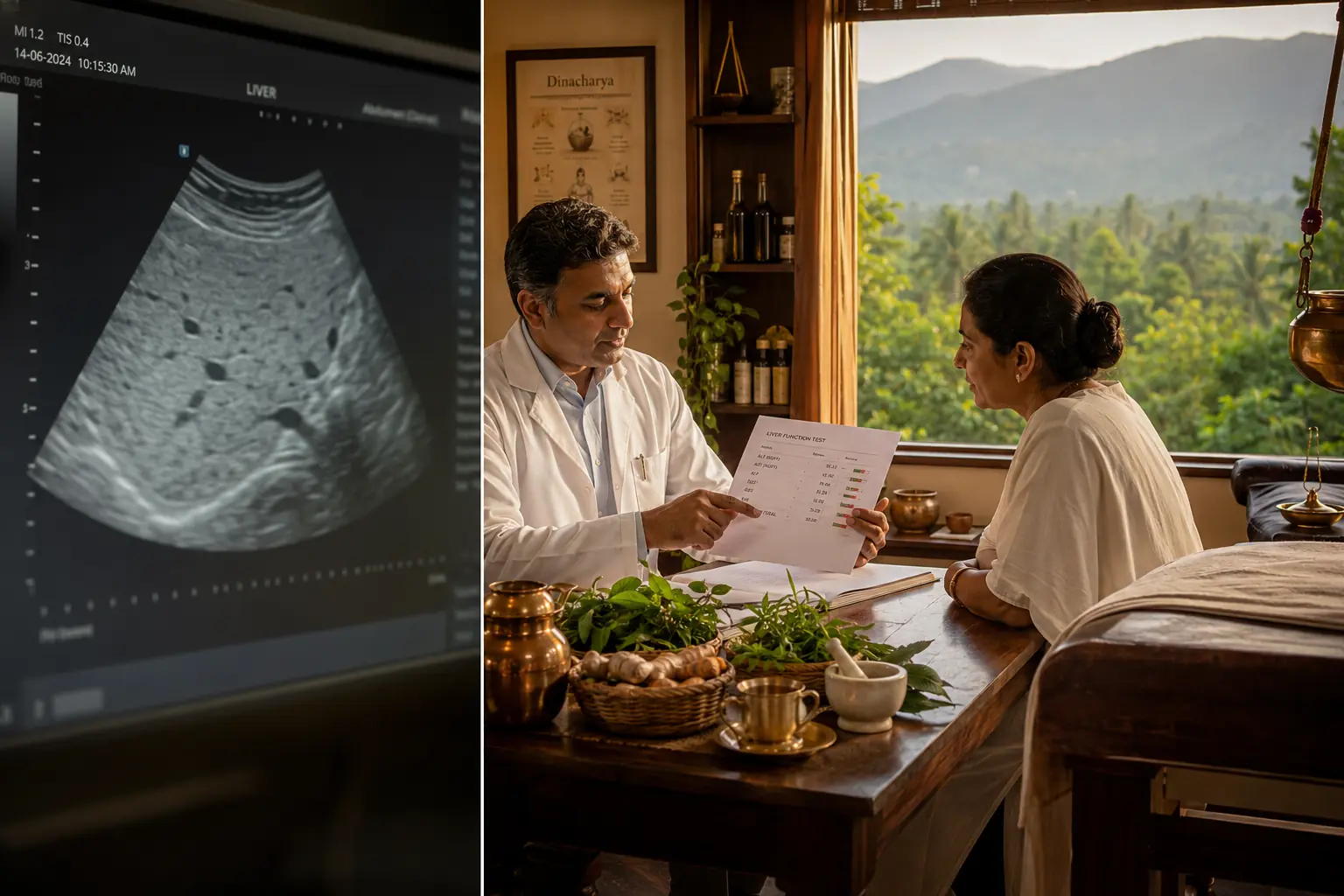
Your doctor ran an ultrasound, saw the findings, and sent you home with three words: lose some weight. No programme. No clinical plan. No explanation of why your liver is accumulating fat or what reversing it requires. Fatty liver disease — the most common liver condition in the Gulf region — is both more serious than most patients are told, and more reversible than conventional medicine currently communicates. This guide explains both.
Table of Contents
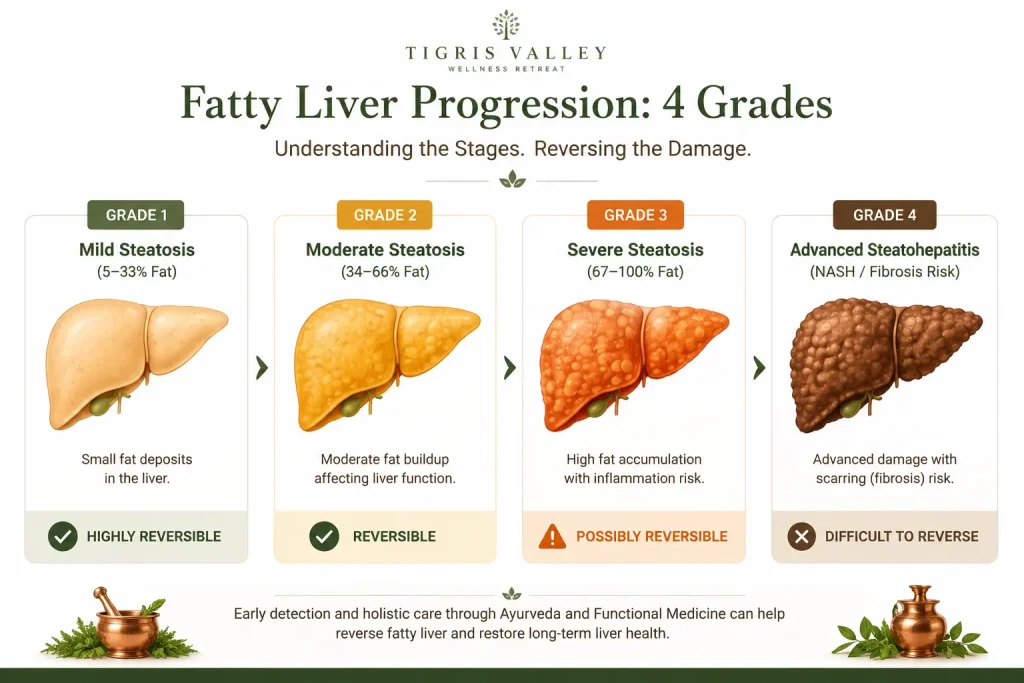
Fatty liver disease occurs when fat accounts for more than 5% of liver weight. In Gulf populations where alcohol consumption is low, this is classified as Non-Alcoholic Fatty Liver Disease (NAFLD). It progresses through four stages:
| Stage | What It Means | Reversibility | Action Required |
|---|---|---|---|
| Grade 1 — Simple Steatosis | Fat in liver cells; no inflammation yet | Highly reversible | Dietary, metabolic, detox intervention |
| Grade 2 — Moderate Steatosis | Increased fat; early liver cell stress | Reversible with sustained intervention | Structured programme; clinical monitoring |
| Grade 3 — NASH | Active liver inflammation and cell damage | Improvable; specialist supervision needed | Hepatologist assessment + integrative programme |
| Grade 4 — Cirrhosis | Permanent liver scarring | Not reversible; progression can be slowed | Specialist hepatology management essential |
The critical reality: Grades 1 and 2 are almost entirely reversible when the underlying metabolic and inflammatory drivers are addressed systematically. Most Gulf patients who receive a fatty liver diagnosis are at Grade 1 or 2 — yet receive no structured intervention.
The Gulf region carries a disproportionately high burden of NAFLD driven by a specific combination of dietary, lifestyle, and genetic factors:
Key Point: Because Gulf populations develop NAFLD at lower BMI thresholds, a person who does not appear overweight may still have significant hepatic fat accumulation. Ultrasound or FibroScan is the only reliable assessment — not appearance or BMI alone.
This is the most common frustration expressed by Gulf patients arriving at Tigris Valley — a fatty liver diagnosis with no accompanying treatment plan. “Lose weight and exercise” is not wrong, but it is incomplete in three specific ways:
The integrative approach at Tigris Valley addresses all three gaps simultaneously — which is why the outcomes differ from lifestyle modification alone.
Ayurveda recognised the liver — Yakrit — as one of the body’s most important organs of transformation for over two millennia. Its clinical framework maps onto modern hepatology with precision.
When Agni (digestive and metabolic fire) is impaired and Ama (unprocessed metabolic toxins) accumulates, fat deposits abnormally — including within the liver, identified in Ayurveda as a site of metabolic fire (Bhutagni) responsible for processing nutrients from the digestive system.
Fatty liver in Ayurvedic clinical practice involves Kapha excess (producing fat accumulation and sluggishness) with underlying Pitta aggravation (driving the inflammatory component seen in NASH). Treatment must address both simultaneously.
Virechanam — medicated purgation — is Ayurveda’s most specifically liver-targeted Panchakarma procedure. Classical texts identify the liver and gallbladder as the primary seat of Pitta, and Virechanam as the procedure indicated for Pitta-driven hepatic conditions. Its mechanism involves hepatic and biliary elimination of accumulated Pitta-Ama through the small intestine — directly addressing the liver’s toxic burden. At Tigris Valley, Virechanam is administered under physician supervision within the Detox & Cleanse Programme and the Metabolic Disorder Management Programme.
Every claim below is drawn directly from Tigris Valley’s confirmed clinical documentation — no unverified claims are made.
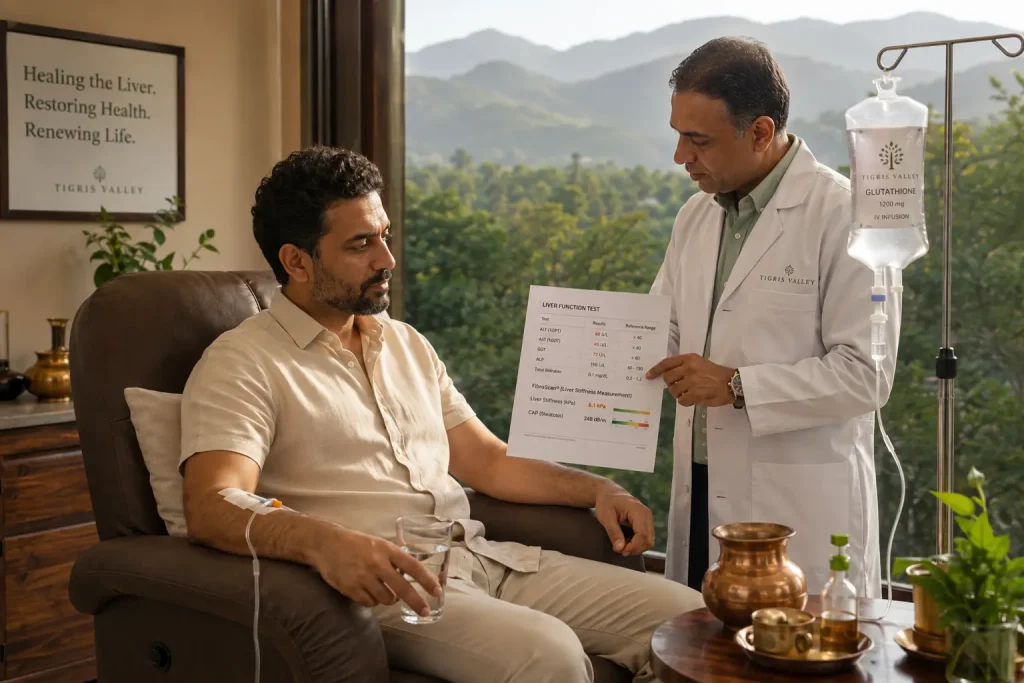
Confirmed benefits at Tigris Valley: “Enhanced liver detoxification — helps remove toxins and chemicals” and explicitly: “Adjunct support in fatty liver conditions.” IV delivery achieves hepatic concentrations that oral glutathione cannot — the most direct intervention for supporting the liver’s own repair capacity.
Confirmed at Tigris Valley: “Enhanced liver detoxification — aids in removal of toxins; supports liver repair and metabolic detox pathways” and “Adjunct support in fatty liver conditions.” ALA also improves insulin sensitivity — addressing one of NAFLD’s primary metabolic drivers.
Confirmed benefits: “Supports liver detox and fat reduction — beneficial in fatty liver and metabolic dysfunction” and “Enhances fat metabolism — helps burn stored fat more efficiently.” Carnitine is essential for transporting fatty acids into mitochondria for oxidation — its deficiency is a documented contributor to hepatic fat accumulation.
Confirmed: “Supports liver detox — helps remove toxins from liver; protects liver cells from chemical or metabolic stress” and “boosts glutathione levels.” NAC is the rate-limiting precursor for intracellular glutathione synthesis — amplifying the liver’s own antioxidant capacity from within.
Confirmed: “Enhances detoxification — supports liver function and improves toxin elimination” alongside anti-inflammatory action. Ozone Therapy’s dual mechanism — reducing inflammatory cytokines while improving hepatic oxygenation — directly addresses both fat accumulation and the inflammatory component of NAFLD.
The Detox & Cleanse Programme confirms Virechanam (medicated purgation) targeting the liver-biliary elimination pathway — mobilising and clearing Pitta-based toxins through the most direct available route in classical Panchakarma.
Confirmed for “supporting detoxification” and “enhancing nutrient absorption.” The gut-liver axis is a well-established physiological relationship: gut dysbiosis directly drives hepatic inflammation through portal vein endotoxin delivery. Colon Hydrotherapy addresses the gut component of NAFLD’s pathological cascade.
All meals are prepared from the on-site Mazra Organic Farm. The therapeutic diet removes primary dietary drivers — refined carbohydrates, fructose, processed fats — while providing the phytonutrients and anti-inflammatory compounds that support liver regeneration. Diet is not supplementary — it is a core clinical intervention.
The following is published on the Tigris Valley website as a documented patient testimonial:
“I’m extremely thankful to Dr. Fahim for the positive transformation in my liver health. When I first met him, my FibroScan results showed advanced fatty liver and fibrosis (F2–F3). With his treatment and guidance, my condition has significantly improved, and my latest results show fatty liver reduced to S2 and fibrosis down to F0–F1. This progress has given me great confidence and relief.”
— Patient testimonial, Tigris Valley
A reduction from F2–F3 fibrosis to F0–F1 represents measurable reversal of structural liver damage — confirmed by FibroScan, an objective imaging-based assessment. This result, achieved under Dr. Fahim Najeeb’s physician-supervised integrative protocol, illustrates what is possible when the full clinical toolkit is applied in a coordinated, sustained programme.
| Phase | Days | Clinical Focus | Key Therapies |
|---|---|---|---|
| Assessment | 1–2 | Full metabolic and liver function profiling; dosha analysis | Lab work, dietary assessment, physician consultation |
| Preparation | 3–7 | Metabolic priming; gut preparation; initial hepatic support | Snehapanam, Abhyanga, IV Glutathione, therapeutic diet begins |
| Active Detox | 8–14 | Hepatic and biliary clearance; fat metabolism activation; inflammation reduction | Virechanam, Basti, IV ALA, IV Levocarnitine, Ozone Therapy, Colon Hydrotherapy |
| Restoration | 15–21 | Liver cell regeneration; metabolic recalibration; sustainable habits | Rasayana Therapy, IV NAC, herbal formulations, Yoga & dietary graduation |
Upon discharge, every guest receives a post-programme protocol: dietary plan for liver health maintenance, customised herbal formulations, and lifestyle guidance. Explore the Metabolic Disorder Management Programme and Detox & Cleanse Programme for full details.

Who should seek hepatologist assessment first: Patients with confirmed cirrhosis, active hepatitis B or C, significant portal hypertension, or advanced fibrosis (F3–F4) require specialist hepatology management and should discuss any integrative programme with their gastroenterologist before booking.
Yes — for Grade 1 and Grade 2 NAFLD, complete reversal is achievable through sustained metabolic and dietary intervention. The liver is one of the body’s most regenerative organs. A medically supervised programme combining detoxification, IV nutritional support, dietary correction, and gut restoration addresses the upstream causes rather than managing downstream consequences. Grade 3 (NASH) can show significant improvement but typically requires longer programmes and specialist hepatology co-management.
Yes — NAFLD is entirely distinct from alcoholic liver disease and is now the most common liver condition globally, including across GCC countries where alcohol consumption is low or absent. The drivers are metabolic: insulin resistance, high-sugar diets, refined carbohydrates, sedentary lifestyle, and genetic predisposition. Alcohol is not required for significant fatty liver accumulation.
Glutathione is the liver’s primary internal antioxidant and detoxification molecule. In fatty liver, oxidative stress depletes hepatic glutathione — impairing the liver’s own repair capacity. IV Glutathione restores this directly, with Tigris Valley’s confirmed documentation specifically noting it as “adjunct support in fatty liver conditions.” IV delivery achieves hepatic concentrations that oral supplements cannot reach.
Standard hospital management of NAFLD in the GCC is largely surveillance-based — monitor liver enzymes, advise weight loss, recheck in six months. Tigris Valley’s approach is active and multi-modal: simultaneously addressing hepatic fat through IV Levocarnitine, hepatic inflammation through IV ALA and Ozone Therapy, detoxification through Virechanam and IV Glutathione, the gut-liver axis through Colon Hydrotherapy, and dietary drivers through a physician-designed therapeutic meal plan. These mechanisms work on different pathways simultaneously.
A meaningful initial programme is 14–21 days residential. The 21-day format allows the full three-phase cycle — preparation, active detox, and liver restoration. Guests with Grade 2–3 typically benefit from 21 days with follow-up protocols extended for 8–12 weeks post-discharge through dietary and herbal home management.
Yes — and the diet is a clinical intervention, not an afterthought. All meals are prepared from the on-site Mazra Organic Farm and specifically designed for each phase of your programme and your dosha constitution. The fatty liver therapeutic diet eliminates fructose, refined carbohydrates, and processed fats while emphasising bitter vegetables, liver-supportive herbs, and anti-inflammatory plant compounds.
The programme structure is adjustable for Ramadan fasting. IV therapy and treatments are administered after Iftar. Dietary protocols follow the Suhoor-Iftar schedule. The Tigris Valley team is experienced with Gulf patients and accommodates religious practice within the clinical framework. Discuss your specific Ramadan schedule during the pre-arrival consultation.
Yes — and the two are clinically connected. The Weight Management Package at Tigris Valley addresses the same metabolic drivers — insulin resistance, impaired fat metabolism — that underlie NAFLD. IV Levocarnitine and dietary protocols serve both goals simultaneously. Your physician will design a programme addressing both dimensions of your metabolic picture.
Comprehensive diagnostics including liver function tests are part of the pre-programme physician assessment. Bring any existing FibroScan, ultrasound, or liver enzyme results from your home country physician to your pre-arrival consultation — this significantly improves the precision of your programme design.
Contact the team at reservation@tigrisvalley.com or WhatsApp +91 9072661622. The first step is a pre-arrival video consultation reviewing your liver diagnosis, investigations, medications, and goals. Flight routing from Dubai, Riyadh, Abu Dhabi, and Doha to Kozhikode (CCJ) via Emirates, Qatar Airways, or Etihad typically takes 4–6 hours including one connection. Use the contact page to submit an initial enquiry.
Your Liver Can Regenerate. With the Right Programme, It Will.
Tigris Valley’s NABH-accredited medical team has documented real FibroScan improvements in fatty liver patients — through IV Glutathione, IV ALA, IV Levocarnitine, Ozone Therapy, Virechanam, and therapeutic organic diet. Your pre-arrival consultation is where it starts.
Explore the Metabolic Disorder Management Programme