

[gtranslate]
MENU
The fatigue persists despite adequate sleep. The cognitive sharpness that used to define you has dulled. Your joints ache without a structural explanation. Standard blood tests come back within normal range, and yet you have not felt like yourself in years. One possibility that remains systematically underinvestigated in conventional medicine is chronic heavy metal toxicity — a condition that is frequently missed, almost always treatable, and increasingly relevant given modern environmental exposure patterns.
⚠️ Medical Disclaimer: Acute heavy metal poisoning is a medical emergency requiring immediate hospital treatment. This article addresses chronic low-level heavy metal exposure — a distinct clinical category. If you suspect acute poisoning (sudden severe symptoms following known exposure), go to an emergency department immediately. The information here is educational and does not constitute medical advice. All testing and treatment should be conducted under qualified physician supervision.
📋 Table of Contents
Heavy metals are naturally occurring elements with high atomic weights. Some — including zinc, iron, copper, and selenium — are essential nutrients at trace levels. Others — including lead, mercury, cadmium, arsenic, and aluminium — have no known beneficial physiological role and are toxic at any significant accumulation level.
Heavy metal toxicity exists on a spectrum with two clinically distinct presentations:
A sudden, high-dose exposure producing rapid, dramatic symptoms — nausea, vomiting, abdominal pain, neurological symptoms, cardiovascular collapse. Causes include industrial accidents, contaminated water events, and intentional ingestion. This is a medical emergency requiring immediate hospital management. It is not the focus of this article.
Gradual accumulation from environmental, dietary, and occupational sources over months or years. Symptoms are non-specific, variable, and frequently attributed to other conditions — making chronic heavy metal toxicity one of the most commonly missed diagnoses in conventional medicine. This is the category that integrative and Functional Medicine approaches, including those at Tigris Valley, are specifically positioned to address.
Chronic exposure is particularly insidious because:
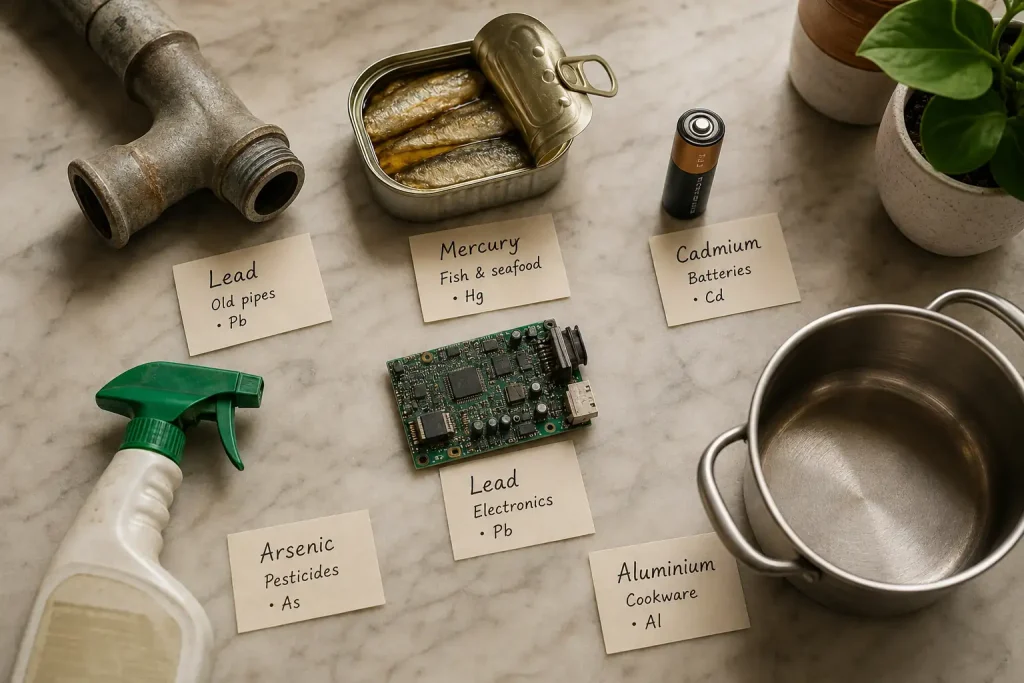
Understanding the sources of chronic heavy metal exposure is essential for both identifying risk and reducing ongoing accumulation during any detox program. The following are the most clinically relevant exposure pathways for each major metal:
| Metal | Primary Exposure Sources | Primary Storage Sites in Body |
|---|---|---|
| Lead (Pb) | Old lead pipes (drinking water), leaded paint in older buildings, some imported ceramics and cosmetics, occupational exposure (battery manufacturing, construction, demolition), contaminated soil in urban areas | Bones (90% of body burden), soft tissues, kidneys, brain |
| Mercury (Hg) | High-mercury fish (tuna, swordfish, shark), dental amalgam fillings, contaminated water near industrial sites, some skin-lightening cosmetics and eye drops, occupational exposure (mining, dental practice) | Brain and nervous system (methylmercury), kidneys, liver |
| Cadmium (Cd) | Tobacco smoke (primary source in non-occupational exposure), contaminated rice and leafy vegetables grown in polluted soil, occupational exposure (battery manufacturing, welding, electroplating) | Kidneys (primary), liver, bone |
| Arsenic (As) | Contaminated groundwater (especially in South Asia, Southeast Asia, and parts of the US), rice (absorbs arsenic from water and soil), pressure-treated wood in older buildings, some pesticides and herbicides, occupational exposure | Skin, hair, nails (inorganic arsenic), liver, kidneys, lungs |
| Aluminium (Al) | Aluminium cookware, antacids, some deodorants and antiperspirants, processed foods using aluminium-based additives, municipal drinking water treatment (aluminium sulphate) | Brain, bone, liver, kidney |
Relevance for International Guests: Tigris Valley’s confirmed IV Chelation Therapy documentation specifically notes it is “useful for people exposed to pollution, chemicals or occupational toxins” — language that reflects the real-world exposure profiles of guests from urban Gulf environments, industrial backgrounds, and regions with groundwater arsenic concerns. This is a clinical tool for a real-world problem, not a precautionary wellness add-on.
The symptom profile of chronic heavy metal toxicity is frustratingly non-specific — which is the primary reason it is so frequently missed. Many symptoms are shared across multiple metals and overlap with other common diagnoses including chronic fatigue syndrome, fibromyalgia, anxiety disorders, and autoimmune conditions.
Clinical Transparency: None of these symptoms is diagnostic of heavy metal toxicity on its own. They are signals that warrant investigation — not confirmation. The overlap with other conditions (autoimmunity, thyroid disease, fibromyalgia, chronic fatigue) is why testing is essential before any detox protocol is initiated.
Understanding the available testing methods — and their specific limitations — is essential for any guest considering heavy metal detox. Not all tests are equivalent, and some widely marketed tests have significant clinical limitations.
| Test Type | What It Measures | Strength | Limitation |
|---|---|---|---|
| Serum (blood) metals panel | Metal levels in circulating blood at the time of the draw | Accurate for recent or ongoing acute exposure; reliable for lead in children | Poor indicator of tissue-stored burden in chronic low-level exposure; metals are cleared from blood rapidly |
| Urine metals — spot or 24-hour | Metals being excreted through the kidneys | 24-hour collection provides better quantification; useful for ongoing exposure assessment | Spot urine varies with hydration; both may underestimate stored burden without provocation |
| Provoked urine metals test | Metals mobilised from tissue stores following a chelating agent dose; urine collected post-challenge | Best available method for estimating tissue-stored body burden; most clinically relevant for chronic exposure | Requires medical supervision; reference ranges for “provoked” samples are not standardised across laboratories; interpretation requires clinical expertise |
| Hair mineral analysis | Metal content deposited in hair shaft during growth (reflects exposure 1–3 months prior) | Non-invasive; useful as a screening indicator for some metals | Highly susceptible to external contamination (shampoo, hair treatments, environmental); laboratory variation is significant; not considered definitive by most toxicologists |
| Bone lead KXRF scanning | Lead stored in bone tissue (the body’s largest lead reservoir) | Most accurate measure of lifetime lead body burden | Specialised equipment; available only at research centres; not widely accessible |
At Tigris Valley, the pre-program physician consultation includes advanced diagnostics relevant to each guest’s exposure history and clinical presentation. The clinical team advises on the appropriate testing approach before any detox protocol begins.
E-E-A-T requires honesty here: heavy metal toxicity exists on a clinical spectrum, and some presentations require conventional medical management before, alongside, or instead of an integrative wellness program.
Seek immediate emergency care if:
Seek urgent specialist assessment (toxicologist or physician) if:
For chronic low-level exposure with non-specific symptoms, an integrative assessment is appropriate: Tigris Valley’s physician team conducts a comprehensive clinical consultation that includes exposure history, symptom mapping, and diagnostic review before any detox protocol is designed. Contact the team to begin this process before travelling.
Ayurveda does not use the terminology of heavy metal toxicity — but its classical understanding of Visha (poison/toxin) and Ama (accumulated metabolic waste) addresses the same physiological territory with clinical depth accumulated over millennia.
Ayurvedic classical texts contain a sophisticated classification of environmental toxins under the category of Visha (poisons). The texts distinguish between Sthavara Visha (inanimate/environmental poisons, including mineral and metallic toxins) and Jangama Visha (poisons from living organisms). Metal-based toxins — including mineral preparations from improperly processed metals — were specifically classified and their clinical presentations, tissue accumulation patterns, and detoxification protocols described in texts including the Ashtanga Hridayam.
When the body’s detoxification capacity — primarily the liver’s biotransformation function and the gut’s elimination efficiency — is overwhelmed, toxins are sequestered in tissue rather than eliminated. In Ayurvedic terms, this is Ama formation in the deeper tissue layers (Dhatu). For heavy metals, which accumulate precisely in these deeper layers (bone marrow in lead toxicity; nervous tissue in mercury toxicity), Panchakarma’s multi-channel detoxification protocol — which specifically targets the deeper Dhatu layers — provides the classical therapeutic framework.
Some fat-soluble toxins, including methylmercury and certain organic metal compounds, preferentially accumulate in fatty tissue (Medo Dhatu) and nervous tissue (Majja Dhatu). Ayurveda’s Snehapanam — internal oleation therapy — is specifically indicated to loosen and mobilise toxins from these fat-based tissue compartments, making them available for elimination through the subsequent Pradhana Karma procedures. This classical mechanism has a modern pharmacokinetic parallel: fat-soluble toxins require specific mobilisation protocols to move them into the aqueous compartments where chelating agents can bind them.
The following therapies are confirmed at Tigris Valley with their heavy metal detox–relevant benefits drawn directly from Tigris Valley’s own clinical documentation. No unconfirmed claims are made.
IV Chelation Therapy is explicitly confirmed at Tigris Valley. The confirmed documentation describes it as follows:
“Chelation therapy uses a medical agent that binds to heavy metals and harmful mineral deposits in the body. These bound toxins are then safely removed through the kidneys, supporting deep detoxification and overall wellness.”
The confirmed benefits include:
IV Chelation Therapy is administered under physician supervision. Kidney function must be assessed before treatment, as metals are cleared through renal excretion — this is part of the pre-program clinical assessment at Tigris Valley.
IV Glutathione is confirmed at Tigris Valley. Glutathione is the body’s primary endogenous antioxidant and the liver’s most important Phase II detoxification molecule. Its confirmed benefits include:
In the context of heavy metal detox, glutathione is directly relevant because: heavy metals generate significant oxidative stress in tissues they accumulate in, and glutathione also participates in the body’s natural metallothionein-mediated metal sequestration and clearance system. IV delivery achieves cellular concentrations that oral glutathione cannot.
IV Alpha Lipoic Acid is confirmed at Tigris Valley. For heavy metal detox, the directly relevant confirmed benefits are:
ALA has a growing research base in heavy metal neurotoxicity — it crosses the blood-brain barrier and has been studied for its ability to reduce mercury and lead-induced oxidative neurological damage. This is presented as emerging evidence, not settled clinical consensus.
IV NAC is confirmed at Tigris Valley. NAC is the rate-limiting precursor for intracellular glutathione synthesis — meaning it directly supports the liver’s capacity to produce its primary detoxification molecule. Confirmed benefits include:
Ozone Therapy is confirmed at Tigris Valley with multiple delivery formats. For heavy metal detox, the relevant confirmed mechanisms are:
The Detox & Cleanse Program at Tigris Valley confirms Panchakarma’s role in “eliminating accumulated toxins from your system” through Snehapanam, Virechanam, and Basti. The relevance to heavy metal detox:
Colon Hydrotherapy is confirmed at Tigris Valley. For heavy metal detox, its relevance lies in its confirmed action: “flushing out accumulated waste, gas, mucus and toxins from the large intestine” and “enhancing the body’s natural detox processes.” The colon is a pathway for elimination of metal-containing bile metabolites and gut-sequestered metals — particularly relevant for arsenic and mercury compounds that undergo enterohepatic circulation.
Infrared Sauna is confirmed in the Detox & Cleanse Program at Tigris Valley for “sweat-induced detoxification and cellular rejuvenation.” Sweat contains measurable concentrations of some heavy metals — particularly arsenic, cadmium, lead, and mercury. While sweat is not the primary elimination pathway for most metals (urine and bile are), sauna-induced sweating provides a complementary elimination channel during a comprehensive detox protocol.

Detoxification is most effective when ongoing exposure is simultaneously reduced. The following are evidence-informed daily practices for reducing heavy metal accumulation — drawn from occupational medicine, toxicology, and nutritional science, not from wellness marketing:
| Practice | Evidence-Based Rationale |
|---|---|
| Test your water source | Drinking water is the primary lead and arsenic exposure route in many regions. Point-of-use water filters certified for heavy metals (reverse osmosis or specific activated carbon) are the most effective intervention. |
| Reduce high-mercury fish consumption | Tuna, swordfish, shark, king mackerel, and tilefish carry the highest methylmercury concentrations. Smaller, shorter-lived fish (sardines, herring, salmon) are lower risk and can be consumed regularly. |
| Choose organic produce where highest-risk crops grow | Crops grown in cadmium- and arsenic-contaminated soils absorb metals readily. Root vegetables (carrots, potatoes) and rice from affected regions carry higher risk. Organic certification does not guarantee low metal content, but avoids additional pesticide-based metal exposure. |
| Use stainless steel or glass cookware | Aluminium cookware leaches measurable aluminium into acidic foods (tomato-based sauces, tamarind, lemon). Switching to stainless steel or glass removes a consistent daily aluminium source. |
| Support liver function daily | The liver is the primary organ of heavy metal biotransformation and biliary excretion. Adequate hydration, avoidance of excess alcohol, and a diet supporting hepatic glutathione production (cruciferous vegetables, adequate protein, sulphur-rich foods) support daily metal clearance. |
| Ensure adequate mineral status | Iron deficiency increases intestinal lead absorption — they share the same transport protein. Calcium, zinc, and selenium compete with cadmium, mercury, and arsenic at absorption and storage sites. Adequate mineral status reduces the bioavailability of toxic metals. |
| Bowel regularity | Metals excreted in bile re-enter the gut for potential reabsorption if bowel transit is slow. Daily bowel movements — supported by adequate fibre, hydration, and the therapeutic diet at Tigris Valley — reduce this enterohepatic recirculation. |
| Avoid tobacco smoke | Tobacco is the primary source of cadmium exposure in non-occupationally exposed populations. Passive exposure is also significant. No safe level of cadmium has been established. |
Explore the full range of detoxification programs at Tigris Valley: the Detox & Cleanse Program provides the most comprehensive multi-channel detox framework. For guests with cardiovascular consequences of metal accumulation, the Cardio-Metabolic Health & Recovery Program integrates IV Chelation Therapy alongside Ayurveda and cardiac rehabilitation. For autoimmune conditions driven or compounded by metal toxicity, the Autoimmune Disorder Management Program provides additional immune-targeted support alongside detoxification.

Standard routine blood panels do not include heavy metal testing. A specific serum heavy metals panel must be requested. Even then, serum testing reflects recent circulating levels — not tissue-stored body burden, which may be significant even when blood levels have normalised. For chronic low-level exposure assessment, a specialist in occupational medicine, toxicology, or integrative medicine should advise on the most appropriate testing approach for your exposure history.
IV Chelation Therapy, administered by qualified physicians in a clinical setting with appropriate pre-treatment renal assessment, is considered safe and is an established medical procedure. Tigris Valley’s confirmed documentation describes it as a physician-supervised protocol. The critical safety requirement is adequate kidney function — as the chelating agent binds metals and the resulting complex must be eliminated through renal excretion. Guests with known kidney impairment must disclose this during the pre-arrival consultation.
Tigris Valley’s confirmed documentation explicitly states IV Chelation Therapy helps eliminate: lead, mercury, cadmium, arsenic, and aluminium. It also confirms utility “for people exposed to pollution, chemicals or occupational toxins.”
This depends significantly on the metal(s) involved, the duration and intensity of exposure, the individual’s baseline organ function, and the depth of tissue-stored burden. Lead stored in bone has a biological half-life measured in decades — it cannot be fully eliminated in a single program. A meaningful clinical improvement in symptoms — reduced fatigue, improved cognitive function, reduced neuropathic symptoms — is typically observed over a 14–21 day intensive program with continued improvement in the weeks following. Multiple programs over time may be appropriate for significant chronic exposure.
Diet can support the body’s natural heavy metal elimination through several mechanisms — supporting liver glutathione production, maintaining bowel regularity to reduce enterohepatic recirculation, and ensuring adequate mineral status to reduce metal bioavailability. However, for established tissue-stored heavy metal burden, dietary measures alone are unlikely to produce meaningful clinical detoxification. They are best understood as the supportive foundation for a clinical detox protocol, not a substitute for it.
Both are relevant through different but complementary mechanisms. IV Chelation Therapy directly binds circulating and chelatable metal complexes for renal elimination — it is the primary clinical tool for mobilising heavy metals. Panchakarma addresses the tissue preparation and multi-channel elimination framework: Snehapanam mobilises fat-stored compounds from tissue compartments; Virechanam and Basti support hepatic and colonic elimination routes; Swedana supports dermal elimination. Together they create the comprehensive multi-pathway approach that single-modality detox cannot match.
Yes — significantly. Children absorb a much higher proportion of ingested lead (up to 50% versus approximately 10% in adults) due to their developing gastrointestinal absorption systems. The developing brain is particularly vulnerable to lead and mercury neurotoxicity at blood concentrations that are asymptomatic in adults. Lead neurotoxicity in children can produce lasting effects on IQ, attention, and behavioural regulation. If children in your household have had elevated lead blood levels, this requires urgent specialist medical management — not a wellness program.
Urban Gulf environments carry several risk factors for chronic heavy metal exposure: high traffic-related lead and cadmium pollution in densely populated cities, industrial proximity in some regions, and historically high consumption of large pelagic fish (mercury). Tigris Valley’s IV Chelation documentation specifically notes its utility for “people exposed to pollution, chemicals or occupational toxins” — a description that accurately captures the urban Gulf exposure profile. The Arabic language support and Unani Medicine integration at Tigris Valley additionally address the cultural and medical preferences of Gulf guests.
Yes — and it is sophisticated. Classical Ayurvedic texts contain an entire sub-discipline called Rasa Shastra — the science of mercury and mineral preparations in medicine. Ayurveda developed detailed protocols for the purification (shodhana) of mercury for therapeutic use, which implies corresponding understanding of its toxic properties when unpurified. The Ashtanga Hridayam describes metallic poisoning patterns with clinical specificity — and the therapeutic approaches in classical Visha Chikitsa (toxin treatment) include Panchakarma procedures precisely aligned with what modern toxicology identifies as appropriate detoxification pathways.
Contact the team at reservation@tigrisvalley.com or call/WhatsApp +91 9072661622. The starting point is a pre-arrival physician consultation reviewing your exposure history (occupational, environmental, dietary), current symptoms, kidney function, and any available prior testing. Your personalised detox protocol — including which IV therapies and Ayurvedic procedures are most appropriate — is designed from this consultation before you travel. Use the contact page to submit an initial enquiry.
Heavy Metal Burden Is Treatable. With the Right Protocol, the Body Recovers.
Tigris Valley’s NABH-accredited medical team combines IV Chelation Therapy (confirmed for lead, mercury, cadmium, arsenic, and aluminium), IV Glutathione, IV Alpha Lipoic Acid, Ozone Therapy, and full Panchakarma detox in a physician-supervised, multi-channel protocol — built around your specific exposure history and clinical presentation.
→ Explore the Detox & Cleanse Program
→ Cardio-Metabolic Health & Recovery (IV Chelation Integration)

Kaithappoyil, in the Western Ghats.
Markaz Knowledge City Road, Kaithappoyil, Adivaram, Kerala
Get directions +91 90726 61622 reservation@tigrisvalley.com
Kaithappoyil, Western Ghats

Before you leave
A physician reads every letter. Book a consultation, or send an inquiry — reservations answers the same day.