

[gtranslate]
MENU
You’re not stupid — and you’re not imagining it. The words that used to come easily now take a moment to arrive. The concentration that carried you through demanding work now drifts after twenty minutes. You feel present but somehow behind glass. Brain fog is not a mood — it is a physiological state with specific, identifiable causes. Understanding what is actually driving it is the first step toward clearing it. This guide does both.
⚠️ Medical Disclaimer: Brain fog can be a symptom of serious underlying medical conditions including thyroid disorders, anaemia, diabetes, multiple sclerosis, depression, and early neurological disease. The information in this article is educational and does not constitute medical advice. If you are experiencing persistent or worsening cognitive symptoms, please seek assessment from a qualified physician before pursuing any wellness program.
📋 Table of Contents
Brain fog is not a clinical diagnosis — it is a descriptive term for a cluster of cognitive symptoms that share a common character: a subjective sense of reduced mental sharpness, clarity, and processing speed that is out of proportion with the person’s baseline capacity and cannot be explained by simple tiredness.
It is important to distinguish brain fog from:
What distinguishes the brain fog addressed in this article is its functional, reversible character — driven by identifiable physiological causes that respond to targeted intervention. The person experiencing this fog typically reports that at certain times (early morning, after a holiday, under optimal conditions) they feel more like themselves — confirming that the underlying cognitive capacity is intact but being blocked by something addressable.
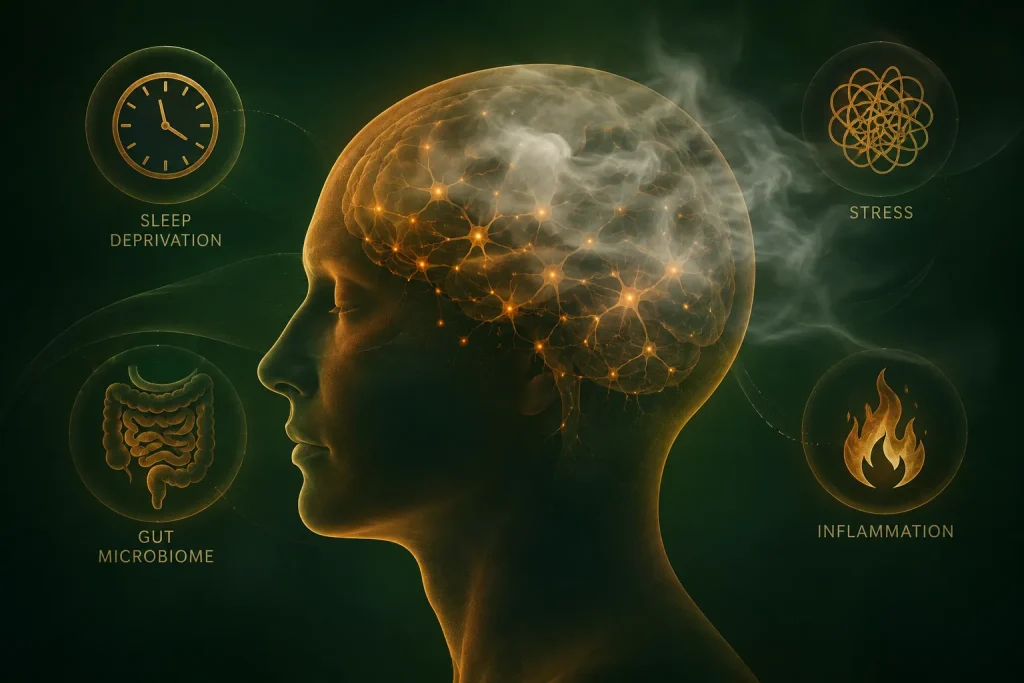
Brain fog is a downstream symptom — its cause is always upstream. The following are the most clinically consistent drivers, based on current medical understanding:
Neuroinflammation — inflammation affecting the brain and central nervous system — is consistently identified in research on brain fog associated with Long COVID, autoimmune conditions, chronic stress, and metabolic disease. Inflammatory cytokines cross the blood-brain barrier and disrupt neurotransmitter metabolism, impair synaptic function, and reduce cerebral blood flow. The result is the characteristic sluggishness and dulling of cognitive processing that patients describe as fog.
This mechanism is why brain fog so frequently accompanies inflammatory conditions — rheumatoid arthritis, lupus, IBD, Hashimoto’s thyroiditis — even when those conditions are not primarily neurological.
The brain is the body’s most metabolically active organ, consuming a disproportionate share of the body’s energy despite its relatively small size. Neurons depend on mitochondria — the cell’s energy factories — to sustain the continuous electrochemical signalling that constitutes thought. When mitochondrial function is impaired — through oxidative stress, nutrient deficiency, chronic illness, or toxin exposure — cognitive processing slows, concentration becomes effortful, and sustained mental work produces rapid exhaustion.
This is the mechanism linking brain fog to chronic fatigue syndrome, post-viral illness including Long COVID, burnout, and metabolic disorders.
The gut and brain communicate bidirectionally via the vagus nerve and through the bloodstream. Gut dysbiosis — an imbalance in the gut microbiome — produces inflammatory compounds and reduces the synthesis of neurotransmitters including serotonin (of which the gut produces approximately 90%) and GABA. Poor gut health is now consistently identified as a contributor to mood disorders, anxiety, and cognitive impairment — including the specific type of cognitive blunting that characterises brain fog.
Sustained elevated cortisol — the primary stress hormone — has measurable neurotoxic effects when chronically elevated. It impairs hippocampal function (the brain region most critical for memory and learning), disrupts prefrontal cortex activity (executive function, concentration, planning), and promotes neuroinflammation. Burnout-associated brain fog is, in most cases, cortisol-mediated cognitive impairment — and it does not resolve through willpower or vacation alone.
Sleep is when the brain’s glymphatic system — a recently discovered waste-clearance mechanism — actively flushes metabolic byproducts, including inflammatory proteins, from neural tissue. Even a few nights of disrupted sleep measurably impairs executive function, working memory, processing speed, and emotional regulation. Chronic sleep disruption accumulates this deficit — and the brain fog that results is not resolved by one good night once the pattern is established.
Several specific micronutrient deficiencies are directly associated with cognitive impairment:
Brain fog is one of the most commonly reported symptoms of Long COVID (Post-Acute Sequelae of SARS-CoV-2) and has also been documented following other viral illnesses including Epstein-Barr virus infection and influenza. The mechanisms under investigation include viral persistence in neural tissue, neuroinflammation, and microbiome disruption following viral illness and antibiotic treatment. Post-viral brain fog is not psychological — it has measurable biological correlates.
Accumulation of heavy metals (lead, mercury, cadmium), pesticide residues, and other environmental toxins has documented effects on neurological function. Exposure through contaminated water, food, or occupational settings can impair neurotransmitter synthesis, disrupt mitochondrial function, and produce cognitive symptoms. This is the category most responsive to targeted detoxification protocols.
Clinical Transparency Note: In most individuals experiencing brain fog, more than one of the above causes is active simultaneously — and they reinforce each other. Chronic stress disrupts sleep; poor sleep impairs gut function; gut dysfunction elevates inflammation; inflammation impairs mitochondria. This is why single-intervention approaches — one supplement, one therapy — typically produce limited results. The integrative approach addresses these drivers in parallel.
Brain fog’s symptom profile is consistent enough to be clinically recognisable even though it is not a formal diagnosis. The following are the most commonly reported presentations:
| Symptom Category | What People Report | Associated Mechanism |
|---|---|---|
| Concentration | “I can’t hold a thought for more than a few minutes”; reading the same paragraph repeatedly | Prefrontal cortex impairment via cortisol / neuroinflammation |
| Word finding | “Words are on the tip of my tongue and won’t come”; speaking more slowly than usual | Disrupted semantic memory access; synaptic inefficiency |
| Working memory | “I walk into a room and can’t remember why”; losing track mid-sentence | Hippocampal impairment; reduced neuronal energy supply |
| Processing speed | “I used to be quick — now I feel like I’m thinking through mud” | Mitochondrial energy deficit; neuroinflammation slowing signalling |
| Mental fatigue | Cognitive exhaustion after 1–2 hours of focused work; needs rest to think again | Depleted neural ATP; oxidative stress accumulation during cognition |
| Spatial disorientation | Difficulty navigating familiar routes; losing track of time | Hippocampal and parietal lobe functional disruption |
| Sensory sensitivity | Noise and light feeling overwhelming; sensory overstimulation quickly exhausting | Autonomic nervous system dysregulation; reduced sensory filtering capacity |
| Depersonalisation | “I feel like I’m watching myself from a distance”; not fully present | Dissociative effect of chronic stress; cortisol impact on limbic system |
This section is included because E-E-A-T requires honesty — and an honest guide on brain fog must distinguish between cognitive symptoms appropriate for integrative wellness approaches and those requiring prompt medical evaluation.
Seek a physician assessment before any wellness program if your brain fog is accompanied by:
Tigris Valley’s physician team conducts a pre-program medical consultation that reviews all of the above. Guests with any of these features will be assessed individually, and program modifications or referrals made where clinically indicated. The NABH-accredited clinical standard at Tigris Valley means this assessment happens before a single therapy begins.
Ayurveda does not use the term “brain fog” — but it describes the condition with clinical precision through its own conceptual architecture.
Manovaha Srotas are Ayurveda’s channels governing mental function — the pathways through which the mind receives, processes, and responds to information. When these channels become obstructed by Ama (unprocessed metabolic toxins) or disturbed by elevated Vata (the governing principle of the nervous system), the result is impaired mental clarity, slowed processing, and difficulty with concentration and memory — the experiential cluster we call brain fog.
Tarpaka Kapha is the specific Kapha sub-type responsible for nourishing and protecting the brain and nervous system. When Tarpaka Kapha is depleted — through chronic stress, inadequate sleep, excessive sensory stimulation, or sustained illness — the brain loses its protective buffering capacity. This depletion is the Ayurvedic equivalent of what modern neuroscience describes as reduced neural resilience, impaired glymphatic clearance, and neuroinflammation.
The most common brain fog pattern in Ayurvedic clinical practice is the combination of elevated Vata (racing, scattered mental activity; inability to settle; poor sleep) with Ama accumulation in the Manovaha Srotas (dullness, heaviness, slowed processing). These are not contradictory — they co-exist as distinct layers of dysfunction that require distinct therapeutic approaches simultaneously.
Nasya Therapy is Ayurveda’s most direct intervention for this channel system. Nasya — the administration of medicated oils through the nasal passages — directly accesses and nourishes the cranial channels that serve the brain and sense organs. Classical Ayurvedic texts specifically indicate Nasya for conditions involving head, neck, and cognitive clarity.
The following approaches have either established or emerging evidence supporting their role in addressing the physiological causes of brain fog. Each is stated with appropriate epistemic caution about the strength of evidence.
The glymphatic system’s function — the brain’s primary waste-clearance mechanism — is almost entirely dependent on adequate sleep, particularly slow-wave (deep) sleep. This is not a wellness claim — it is established neuroscience from research published in the journal Science by the Nedergaard laboratory at University of Rochester. Improving sleep quality is the single intervention with the most robust evidence base for reducing brain fog driven by accumulated neural metabolic waste.
Anti-inflammatory dietary and lifestyle changes — eliminating ultra-processed foods, reducing refined sugar, increasing omega-3 intake, addressing gut dysbiosis — have consistent evidence for reducing neuroinflammatory markers. Studies on inflammatory biomarkers in brain fog populations show that reducing peripheral inflammation improves cognitive symptom scores.
Targeted nutritional interventions supporting mitochondrial function — including Alpha Lipoic Acid, L-Carnitine (Levocarnitine), and N-Acetylcysteine (NAC) — have evidence from both in vitro and clinical studies for improving markers of mitochondrial efficiency and reducing oxidative stress. The clinical evidence in human brain fog populations is growing but not yet at RCT scale for all compounds. Tigris Valley’s IV formulations of these compounds are drawn from established clinical nutritional medicine.
Controlled breathing practices (Pranayama) have documented effects on heart rate variability, autonomic nervous system balance, cortisol levels, and prefrontal cortex activation. Studies published in neuroscience and integrative medicine journals have shown that regular Pranayama practice improves sustained attention, reaction time, and cognitive flexibility. Tigris Valley’s confirmed Pranayama program includes this as a daily component of the Mindfulness & Mental Clarity package and the Stress & Burnout Recovery Program.
Forest Bathing (Shinrin-yoku) has a well-established evidence base — primarily from Japanese research institutions — demonstrating measurable reductions in salivary cortisol, improvements in natural killer cell activity, and subjective improvements in cognitive clarity and mood following guided forest immersion. Tigris Valley’s confirmed Forest Bathing programme is specifically noted for “cortisol reduction and mental clarity” in its Stress & Burnout Recovery Program documentation.

The following therapies are confirmed at Tigris Valley as administered treatments, with their cognitive clarity benefits drawn directly from Tigris Valley’s own clinical documentation. No unconfirmed claims are made.
Nasya is Ayurveda’s primary treatment for conditions of the head and neck. Confirmed as a treatment at Tigris Valley’s Ayurveda programme, it involves the administration of medicated oils through the nasal passages to directly nourish and clear the cranial channels governing cognitive and sensory function. It is among the most consistently recommended Panchakarma therapies for patients presenting with brain fog, migraines, sinus congestion, and cognitive impairment linked to blocked Manovaha Srotas.
Shirodhara — confirmed at Tigris Valley — involves a continuous, calibrated stream of warm herbal oil poured over the forehead. Tigris Valley’s own documentation describes it as calming “the nervous system with a warm herbal oil flow” and contributing to reduced “mental fog” and improved “mental sharpness.” Its mechanism involves direct stimulation of the prefrontal cortex region through therapeutic tactile and thermal input — interrupting the neurological hyperactivation loop that characterises stress-driven brain fog.
IV Alpha Lipoic Acid is a confirmed therapy at Tigris Valley. Tigris Valley’s own clinical documentation states it: “reduces brain fog,” “supports mitochondrial energy production,” and “helps improve focus and cognitive performance.” ALA is a powerful antioxidant that crosses the blood-brain barrier — addressing neuroinflammation and oxidative stress directly within the brain’s cellular environment.
IV Levocarnitine (L-Carnitine) is confirmed at Tigris Valley. Clinical documentation states it provides “brain & nerve support,” specifically “helps reduce brain fog and improves mental clarity” by “enhancing mitochondrial energy production” and “reducing fatigue.” Levocarnitine facilitates the transport of fatty acids into mitochondria for energy production — addressing the cellular energy deficit that drives cognitive slowing.
IV NAC is confirmed at Tigris Valley. Tigris Valley’s documentation describes it as providing “brain & mood support” through helping “regulate neurotransmitters” and supporting “strong antioxidant support” that “reduces oxidative stress and inflammation.” NAC is a glutathione precursor — supporting the brain’s primary antioxidant defence system — and has a growing research base in cognitive function and neuroinflammation.
Hydrogen Therapy is confirmed at Tigris Valley, offered via IV, inhalation, and hydrogen water. Tigris Valley’s confirmed documentation describes it as having “neuroprotective effects” — specifically “protects brain and nervous system from damage caused by oxidative stress and inflammation” — alongside “anti-oxidant effects” that “neutralize free radicals.” These neuroprotective mechanisms are directly relevant to neuroinflammation-driven brain fog.
Ozone Therapy is confirmed across multiple delivery formats at Tigris Valley. For cognitive clarity, its most relevant confirmed mechanisms are: “improves oxygenation” — enhancing cellular metabolism and energy production — and “anti-inflammatory effects.” Improved cerebral oxygenation is directly relevant to the cognitive sluggishness driven by hypoperfusion and mitochondrial energy deficit.
All three are confirmed components of the Stress & Burnout Recovery Program and the Mindfulness & Mental Clarity Package. Forest Bathing is specifically confirmed as providing “cortisol reduction and mental clarity.” Pranayama is confirmed for “regulating stress responses” and “cultivating emotional balance and mental clarity.” Guided Meditation contributes to “emotional balance and mental clarity” per Tigris Valley’s programme documentation.
Brain fog with a gut-inflammatory or systemic toxin component responds to Panchakarma’s multi-channel detoxification protocol. The Detox & Cleanse Program explicitly lists “improve focus, clarity, and mental sharpness” and “alleviate stress and mental fatigue” among its confirmed mental and emotional benefits — reflecting the well-established downstream effect of reducing systemic Ama load on cognitive function.

The integrative program at Tigris Valley addresses brain fog clinically — but what you do daily in the months before and after determines whether fog accumulates in the first place. The following are drawn from established lifestyle medicine evidence:
| Factor | Clarity-Building | Fog-Generating |
|---|---|---|
| Sleep | Consistent 7–9 hours; dark room; regular wake time; screen-free 60 min before bed | Irregular sleep; chronic debt; blue light until midnight; late heavy meals |
| Diet | Whole foods; adequate protein; omega-3-rich sources; fermented foods for microbiome; warm meals | Ultra-processed foods; refined sugar spikes; alcohol; excessive caffeine; cold and raw foods |
| Hydration | Consistent warm water throughout the day; herbal teas; avoiding alcohol and excessive coffee | Chronic mild dehydration (even 1–2% reduces cognitive performance measurably) |
| Stress management | Daily Pranayama or breathwork; scheduled transitions between work and rest; nature exposure | Always-on working; no boundaries between work and rest; chronic low-grade cortisol elevation |
| Movement | Daily moderate movement; post-meal walks; yoga; stimulates BDNF (brain-derived neurotrophic factor) | Prolonged sitting; no movement for hours; sedentary work patterns |
| Screen / information | Scheduled focus blocks; single-tasking; digital-free periods; reading linear text | Continuous multitasking; constant notifications; short-form content consuming working memory |
| Nature exposure | Daily time outdoors, ideally in natural settings; reduces cortisol and restores directed attention | Extended periods in built environments; no outdoor exposure; artificial light dominating the day |
Guests completing the Mindfulness & Mental Clarity Package or the Stress & Burnout Recovery Program at Tigris Valley leave with a personalised version of this framework — specific to their dosha, their identified triggers, and their home environment — as part of the post-discharge protocol. Explore the full program range and the Emotional Healing & Mental Health Program for those whose brain fog has a significant psychological dimension.
Brain fog is not a formal medical diagnosis — it is a descriptive term for a symptom cluster involving reduced cognitive sharpness, concentration, and processing speed. It is not the same as tiredness, which resolves with rest. Brain fog persists, is out of proportion to sleep quality, and has identifiable physiological causes including neuroinflammation, mitochondrial dysfunction, gut dysbiosis, cortisol dysregulation, and nutritional deficiency. It requires a physician assessment to exclude underlying medical conditions before pursuing wellness approaches.
Tigris Valley’s confirmed clinical documentation describes Shirodhara as calming the nervous system and contributing to reduced mental fog and improved mental sharpness. Its mechanism is the direct therapeutic stimulation of the forehead — rich in neural pathways connecting to the prefrontal cortex — through sustained warm oil application. This interrupts the neurological hyperactivation loop that underpins stress-driven cognitive impairment. Clinical experience at integrative Ayurveda hospitals consistently shows measurable subjective improvement in cognitive clarity following sustained Shirodhara courses.
Alpha Lipoic Acid (ALA) is a powerful antioxidant that, unlike many antioxidants, crosses the blood-brain barrier — enabling it to act directly within neural tissue. Tigris Valley’s confirmed documentation states it reduces brain fog, supports mitochondrial energy production, and improves focus and cognitive performance. It addresses two of brain fog’s core mechanisms: oxidative stress within neurons and mitochondrial energy deficit impeding cognitive processing.
Post-COVID brain fog (a key symptom of Long COVID) shares the same core physiological drivers as other types of brain fog — neuroinflammation, mitochondrial dysfunction, gut dysbiosis — but is often more severe and persistent due to the direct viral neurological impact, the inflammatory cascade of acute COVID-19 illness, and microbiome disruption following illness and antibiotic treatment. The same integrative framework addresses it — but typically requires a longer program duration and specifically targeted protocols. See Tigris Valley’s Post-Trauma & Rehabilitation Program.
This depends substantially on the duration and cause of the brain fog. Guests at Tigris Valley completing a 14–21 day residential program with Nasya, Shirodhara, IV therapies, Pranayama, and detox typically report measurable improvement in concentration and cognitive clarity within the first week, with progressive deepening through the second and third weeks. Post-discharge continuation of the herbal and dietary protocol typically produces further improvement over 4–8 weeks. Chronic or post-viral brain fog may require longer programs or repeat visits.
Diet is one of the most powerful levers for addressing gut-driven and inflammation-driven brain fog — but rarely sufficient as a standalone intervention when the cognitive impairment is moderate to severe. The most consistent outcomes in integrative medicine come from addressing multiple drivers simultaneously: sleep, diet, stress management, targeted supplementation, and gut restoration together. Tigris Valley’s programs address all of these in a coordinated residential protocol rather than sequentially.
Nasya at Tigris Valley is administered by trained Ayurvedic physicians. The procedure involves the careful instillation of warm medicated oil drops into the nasal passages — a process that most guests describe as mild and tolerable, occasionally producing a slight sensation of warmth or mild reflexive sneezing. The procedure is not painful. The nasal passages are prepared through gentle pre-procedure massage and steam inhalation to make the process more comfortable.
Hydrogen Therapy has a growing pre-clinical and emerging clinical evidence base for neuroprotective effects. Tigris Valley’s confirmed documentation describes it as having “neuroprotective effects” — specifically protecting the brain and nervous system from damage caused by oxidative stress and inflammation. The clinical research in human brain fog populations is emerging rather than settled — and is presented as such in this article. At Tigris Valley, it is integrated within a multi-modal program rather than used as a standalone intervention.
Yes. Brain fog in young people is increasingly reported, particularly in association with post-viral syndromes, disrupted sleep patterns, excessive screen time, and diets high in ultra-processed foods. Tigris Valley’s programs are primarily designed for adults. Parents seeking support for brain fog in minors should seek assessment from a paediatric physician or integrative medicine specialist before pursuing any wellness program.
Contact the team at reservation@tigrisvalley.com or call/WhatsApp +91 9072661622. The starting point is a pre-arrival physician consultation reviewing your cognitive symptoms, health history, current medications, and program objectives. Your personalised protocol — including which specific IV therapies, Ayurvedic procedures, and mind-body practices are most appropriate — is designed from this consultation before you travel. Use the contact page to submit an enquiry.
Mental Clarity Is Not a Luxury — It Is a Physiological State You Can Restore
Tigris Valley’s NABH-accredited medical team addresses brain fog at its actual causes — neuroinflammation, mitochondrial dysfunction, cortisol dysregulation, gut-brain disruption — through a personalised combination of Nasya, Shirodhara, IV Alpha Lipoic Acid, IV Levocarnitine, Pranayama, and Panchakarma detox. Your consultation is the first step.
→ Explore the Mindfulness & Mental Clarity Package