

[gtranslate]
MENU
Arthritis doesn’t just hurt — it quietly steals your mornings, limits your movement, and chips away at the life you want to live. Millions of people manage it with painkillers that offer relief today but create new problems tomorrow. The good news? A scientifically backed, non-invasive option is gaining serious momentum. Hydrogen therapy for arthritis targets the very root of joint damage — oxidative stress and inflammation — without the side effects of long-term medication. This guide breaks down exactly how it works, what the science says, and how you can access it.

Hydrogen therapy is a form of treatment that introduces molecular hydrogen (H₂) into the body — through inhalation, hydrogen-rich water, or intravenous administration — to counteract cellular damage caused by free radicals. Molecular hydrogen is the smallest and most bioavailable antioxidant molecule known to science, capable of penetrating cell membranes and even crossing the blood-brain barrier with ease.
Unlike synthetic antioxidants, molecular hydrogen selectively neutralises only the most harmful free radicals — particularly hydroxyl radicals (•OH) — without disrupting the beneficial reactive oxygen species that the body needs for normal cellular signalling. This selective action is what makes hydrogen therapy so uniquely promising for inflammatory conditions like arthritis.
At Tigris Valley Wellness Retreat, hydrogen therapy is offered as part of an integrative healing model that addresses chronic pain, inflammation, and systemic health at the root level.

Arthritis is not a single disease — it is an umbrella term for more than 100 conditions that affect joint health. The two most prevalent forms are:
Both conditions share a common biochemical denominator: elevated oxidative stress. When free radicals accumulate faster than the body can neutralise them, they accelerate cartilage breakdown, trigger inflammatory cytokine cascades, and damage synovial tissue. Conventional medicine manages symptoms through NSAIDs, corticosteroids, and disease-modifying antirheumatic drugs (DMARDs) — all effective, but associated with long-term risks including gastrointestinal damage, immune suppression, and cardiovascular complications.
This is precisely where hydrogen therapy steps in as a complementary, root-cause approach.
The mechanism of hydrogen therapy for arthritis operates across three interconnected pathways:
Molecular hydrogen directly scavenges hydroxyl radicals (•OH) and peroxynitrite (ONOO⁻) — the two most cytotoxic free radicals implicated in joint tissue destruction. By neutralising these molecules specifically, hydrogen reduces oxidative damage to cartilage, synovial fluid, and surrounding connective tissue without suppressing normal immune functions.
Research indicates that molecular hydrogen can downregulate pro-inflammatory cytokines — including TNF-α, IL-1β, and IL-6 — which are the primary drivers of joint inflammation in both osteoarthritis and rheumatoid arthritis. Reduced cytokine activity translates directly into less joint swelling, reduced morning stiffness, and improved mobility.
Chronic arthritis frequently involves nerve sensitisation and pain amplification pathways. Hydrogen’s neuroprotective properties help protect joint-adjacent nerve tissue from oxidative damage, while simultaneously supporting mitochondrial function — which accelerates cellular repair in damaged cartilage and synovial lining.
At Tigris Valley, these mechanisms are supported through a personalised treatment framework that includes Ayurvedic therapies, Unani medicine, and functional medicine interventions — all working together for comprehensive joint health restoration.

Hydrogen therapy for arthritis delivers a wide range of clinically relevant benefits, particularly when integrated with a holistic wellness programme:
These benefits position hydrogen therapy as one of the most promising complementary interventions for arthritis management available today — and one that aligns seamlessly with the integrative programmes offered at Tigris Valley’s Chronic Pain & Inflammation Management Program.
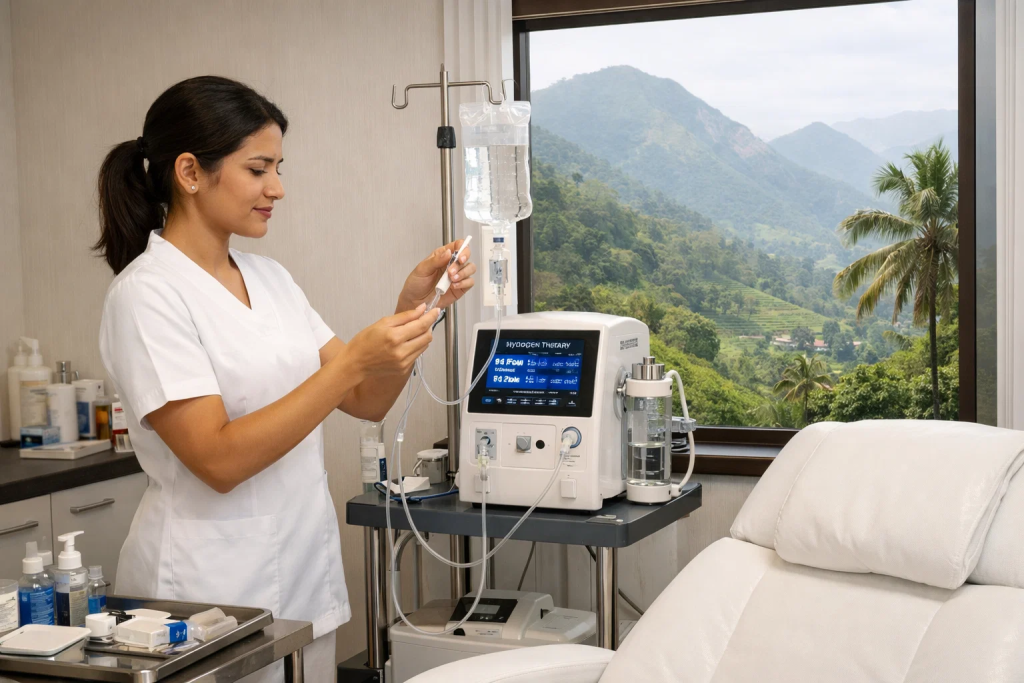
At Tigris Valley Wellness Retreat, hydrogen therapy is delivered in three evidence-aligned formats, each suited to different clinical goals and patient preferences:
The most potent delivery method, where hydrogen-enriched saline is administered directly into the bloodstream via intravenous infusion. This ensures maximum bioavailability of molecular hydrogen, with rapid distribution to inflamed joint tissue. Ideal for patients with moderate to severe arthritis or those seeking faster therapeutic results.
Patients inhale a precise concentration of hydrogen gas through a nasal cannula or mask. This method is non-invasive, comfortable, and highly effective for systemic inflammation management. Sessions are typically 30–60 minutes and can be combined with relaxation or meditation.
A foundational and accessible form of hydrogen therapy. Patients consume water saturated with dissolved molecular hydrogen. While lower in potency compared to IV or inhalation routes, daily hydrogen water consumption provides ongoing antioxidant support and complements in-clinic treatments.
All hydrogen therapy modalities at Tigris Valley are administered under expert medical supervision as part of a comprehensive, personalised wellness plan — not as a standalone intervention.
At Tigris Valley, every hydrogen therapy journey begins with a thorough medical consultation. Here is what patients can expect:
Hydrogen therapy is appropriate for a broad range of individuals, including:
Those with certain conditions — including severe cardiovascular disease or pregnancy — should always consult with a qualified physician before beginning hydrogen therapy.
Tigris Valley’s Autoimmune Disorder Management Program and Anti-Aging & Longevity Program both incorporate hydrogen therapy protocols for eligible guests.
| Feature | Hydrogen Therapy | NSAIDs / Corticosteroids |
|---|---|---|
| Mechanism | Targets oxidative stress and cytokine pathways | Symptom suppression |
| Side Effects | Minimal to none reported | GI damage, immune suppression, cardiovascular risks |
| Long-Term Safety | High | Moderate to Low |
| Approach | Root-cause, cellular | Symptomatic relief |
| Complementary Use | Yes — works with other therapies | Limited combination options |
The most transformative outcomes with hydrogen therapy for arthritis are achieved not in isolation but as part of a comprehensive integrative programme. At Tigris Valley, guests benefit from a multi-disciplinary approach that includes:
This synergistic approach is what distinguishes Tigris Valley from single-modality treatment centres. Learn more about the full range of therapeutic options in the Wellness Programs section.
Hydrogen therapy for arthritis involves introducing molecular hydrogen (H₂) into the body through inhalation, IV infusion, or hydrogen-rich water. It works by neutralising harmful free radicals that drive joint inflammation and cartilage breakdown, offering a natural, root-cause approach to arthritis management.
Yes. Hydrogen-rich water delivers dissolved molecular hydrogen that acts as a selective antioxidant in the body. Regular consumption has been shown to reduce oxidative stress markers and inflammatory cytokines associated with joint pain, particularly in early to moderate arthritis.
The number of sessions varies based on arthritis severity and type. Most patients begin noticing improvements in pain and mobility within 4–8 sessions. A personalised treatment protocol is designed after a detailed initial assessment by a Tigris Valley physician.
Hydrogen inhalation therapy has an excellent safety profile with no known serious adverse effects reported in current clinical literature. It is non-toxic, non-flammable at therapeutic concentrations, and suitable for most arthritis patients, including those on existing medication.
Hydrogen therapy is best positioned as a complementary treatment rather than a direct replacement for prescribed arthritis medication. It can, over time, reduce the need for high-dose medications — but any changes to existing prescriptions should be guided by your attending physician.
IV hydrogen therapy provides the highest bioavailability and is often recommended for moderate to severe rheumatoid arthritis. For mild cases or ongoing maintenance, hydrogen inhalation and hydrogen-rich water are effective alternatives.
Molecular hydrogen downregulates the production of pro-inflammatory cytokines such as TNF-α, IL-1β, and IL-6 — the primary molecular drivers of joint swelling and pain. It also neutralises hydroxyl radicals that directly damage cartilage and synovial tissue.
Both therapies address inflammation through different mechanisms. Hydrogen therapy selectively neutralises damaging free radicals, while ozone therapy improves oxygen delivery and activates the body’s own antioxidant defence systems. At Tigris Valley, the two are often used together for enhanced results.
Yes. Hydrogen therapy is gentle, non-invasive, and particularly well-suited for elderly patients who may not tolerate high-dose pharmacological treatments well. It supports joint health, energy levels, and systemic wellbeing simultaneously.
Tigris Valley Wellness Retreat in Kerala offers medically supervised hydrogen therapy as part of its integrative pain management and holistic healing programmes. Contact Tigris Valley to book a consultation and learn which hydrogen therapy protocol is right for your condition.
Arthritis does not have to define how you live, how you move, or how you start your mornings. The emerging science around hydrogen therapy for arthritis points clearly in one direction: targeting oxidative stress and inflammatory cytokines at the cellular level — rather than masking pain at the surface — is a more intelligent, more sustainable approach to joint health.
Whether you are managing osteoarthritis, navigating the immune complexity of rheumatoid arthritis, or simply looking to protect your joints before damage accumulates, molecular hydrogen offers a safe, non-invasive, and scientifically credible addition to your wellness strategy. The key lies in integrating it within a programme that addresses the whole person — not just the joint.
At Tigris Valley Wellness Retreat, hydrogen therapy is not an isolated treatment. It sits at the centre of a holistic healing architecture that combines Ayurveda, functional medicine, Unani therapies, personalised nutrition, and the restorative power of Kerala’s mountain environment. The result is not just reduced joint pain — it is a measurably better quality of life.
Your joints have carried you this far. It is time to give them the care they deserve.
Ready to Experience Hydrogen Therapy for Arthritis at Tigris Valley?
Take the first step toward lasting joint relief and whole-body wellness. Our expert physicians will design a personalised hydrogen therapy protocol — combined with Ayurvedic and functional medicine treatments — tailored precisely to your condition and goals.
Book Your Consultation at Tigris Valley →
Or explore our Chronic Pain & Inflammation Management Program to discover the full scope of integrative treatments available for arthritis and joint health at our Kerala wellness retreat.

Kaithappoyil, in the Western Ghats.
Markaz Knowledge City Road, Kaithappoyil, Adivaram, Kerala
Get directions +91 90726 61622 reservation@tigrisvalley.com
Kaithappoyil, Western Ghats

Before you leave
A physician reads every letter. Book a consultation, or send an inquiry — reservations answers the same day.