
[gtranslate]
MENU
You’ve researched Panchakarma across Bali, Thailand, and multiple Indian states — but every serious trail leads back to Kerala. There’s a reason for that. Kerala is not simply a popular destination for Panchakarma; it is the origin, the standard, and still the benchmark that every other region is measured against. This guide breaks down exactly why international guests — from Europe, the Middle East, and across the globe — make the journey to Kerala, and what separates a genuine clinical Ayurveda experience from a wellness holiday in disguise.
Table of Contents
While Ayurveda as a system originated across the Vedic Indian subcontinent, the specific clinical practice of Panchakarma as a formalised, residential therapeutic system was preserved and refined in Kerala’s Ashtavaidya families — hereditary lineages of Ayurvedic physicians who maintained the classical protocols with extraordinary fidelity over centuries.
This is not a marketing claim. Kerala’s Panchakarma tradition is distinguished by several concrete features that differentiate it from Ayurveda practiced elsewhere:
When international guests seek authentic Panchakarma — the medically structured, physician-supervised protocol rather than a diluted commercial version — they come to Kerala because the original lives here.
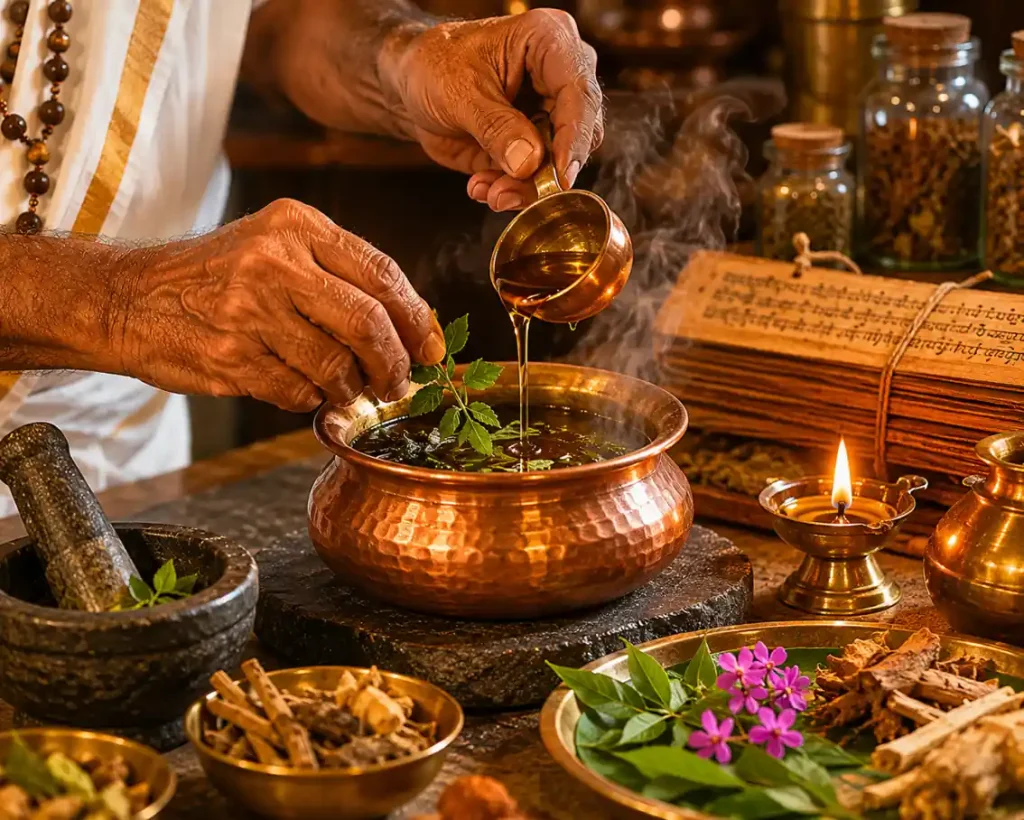
Kerala’s climate is a core medical variable in Panchakarma outcomes — not a backdrop feature. Classical Ayurvedic texts identify the ideal conditions for Panchakarma as warm, humid environments where the body’s channels (srotas) remain naturally dilated and the skin’s pores stay open and receptive to herbal oil absorption. Kerala’s combination of consistent warmth, high humidity, and clean mountain air creates precisely this physiological environment — consistently, year-round.
| Factor | Kerala’s Advantage | Effect on Panchakarma |
|---|---|---|
| Climate | Warm, humid, temperate year-round | Pores remain open; herbal oil absorbs more deeply into tissue |
| Medicinal Plants | Western Ghats — one of the world’s 36 biodiversity hotspots | Fresh, locally sourced medicinal herbs of the highest potency |
| Air Quality | Dense forest, clean mountain air, minimal pollution | Supports respiratory and cellular detoxification during cleanse |
| Water | Mountain spring water, mineral-rich, clean | Supports hydration, herbal decoctions, and medicated baths |
| Monsoon Season | June–August: classical optimal Panchakarma window | Body maximally receptive to deep detox; classical texts confirm this timing |
Wayanad — where Tigris Valley is located — sits within the Western Ghats at elevation, offering all of Kerala’s climatic advantages combined with the additional therapeutic benefits of mountain air, biodiversity-rich forest, and the cortisol-reducing effect of deep nature immersion.
One of the most significant concerns international guests carry when booking Panchakarma outside India is whether the practitioners are genuinely trained — or whether they completed a short-form certification and are now performing medicated enemas and internal oil therapies on paying guests.
Kerala’s Ayurvedic practitioner community is governed by a rigorous educational and licensing framework. Qualified vaidyas complete a 5.5-year BAMS (Bachelor of Ayurvedic Medicine and Surgery) degree, often followed by postgraduate specialisation. The most experienced practitioners come from families where Panchakarma knowledge was transmitted across generations — a living tradition, not a reconstructed one.
Key Insight: When evaluating a Kerala for Panchakarma retreat, ask specifically: Are therapies administered by BAMS-qualified physicians or by trained therapists under physician supervision? Is there 24/7 medical oversight? Is the facility NABH-accredited? At Tigris Valley, all three answers are yes — and these are the non-negotiables every serious international guest should verify before booking.
A critical distinction that experienced wellness travellers understand — and first-timers often discover after a disappointing experience — is the difference between an AYUSH-integrated hospital and a wellness retreat offering Ayurveda services.
Most destinations outside Kerala offer the latter: a beautiful resort that has added Ayurvedic massage to its menu. Kerala’s leading Panchakarma centres are medical institutions where Ayurveda is the clinical system, with physician consultation, diagnostic assessment, medically sequenced therapies, and documented treatment protocols.
Tigris Valley’s AYUSH programme represents the most comprehensive version of this integrated model, combining:
This breadth, under NABH accreditation with 24/7 medical oversight, is what international guests mean when they say they want a “proper” Panchakarma experience — and it is what brings them to Kerala specifically.
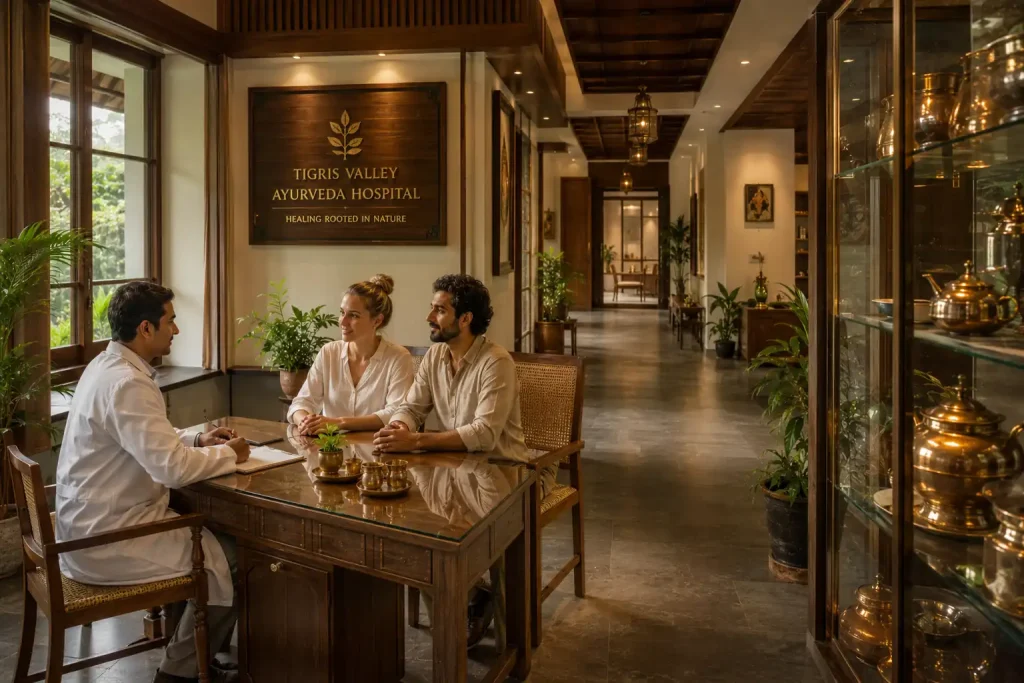
Kerala has a deep, centuries-old relationship with the Arab world — through trade, migration, and cultural exchange. Today, this manifests in a wellness context uniquely suited to Middle Eastern guests seeking Kerala for Panchakarma.
Tigris Valley’s integration of Unani Medicine — the classical Islamic medical tradition that shares foundational roots with Greco-Arabic medicine — makes the retreat philosophically and medically familiar to Arab guests in a way that purely Ayurvedic centres are not. Hijama (wet cupping), a practice well-established in Islamic prophetic medicine, is a confirmed therapeutic offering at Tigris Valley and is used within the detox and pain management programs.
Kozhikode (Calicut) International Airport — the nearest major airport to Tigris Valley — has direct flights from Riyadh, Dammam, Jeddah, Dubai, Abu Dhabi, Muscat, and Doha. The flight time from Dubai is under 2.5 hours. This makes Kerala one of the most accessible international wellness destinations for Gulf residents. Full journey details are on the Getting to Tigris Valley page.
Tigris Valley provides Arabic language support staff — a confirmed facility feature. For guests whose English is limited, or who prefer to receive medical information in Arabic, this removes a significant barrier that exists at most Indian wellness centres.
Kerala’s culinary culture means halal-compatible food preparation is culturally embedded — not a special accommodation request. The retreat’s organic, locally sourced meals align naturally with halal dietary requirements.
European wellness tourists — particularly from Germany, France, the UK, Switzerland, and the Netherlands — represent a significant portion of Kerala’s international Panchakarma visitors. Their motivations are distinct and worth understanding separately.
European guests, particularly from German-speaking countries, often approach Panchakarma as preventive medicine — not crisis care. They arrive well, seek a deep annual reset, and return because the outcomes are consistently measurable: better sleep, clearer skin, reduced inflammation, and sustained energy that lasts months after returning home.
Many European guests come specifically because their chronic conditions — fatigue, autoimmunity, metabolic disorders, stress-related illness — have been inadequately managed by their home healthcare systems. Tigris Valley’s Detox & Cleanse Program and Stress & Burnout Recovery Program directly serve this need.
Experienced European wellness travellers research NABH accreditation, physician qualifications, and whether therapies are medically sequenced or menu-selected. Kerala’s clinical Ayurveda tradition — and hospitals like Tigris Valley — meet this standard in ways that Bali or Thailand-based “Ayurveda retreats” typically cannot.
Not all Kerala Panchakarma centres are equal. International guests investing significant time and travel should evaluate centres against these non-negotiable criteria:
| Criterion | What to Verify | Red Flag |
|---|---|---|
| Medical Accreditation | NABH accreditation confirmed | No accreditation; claims it is “in process” |
| Physician Oversight | BAMS-qualified doctors; 24/7 medical support | Therapists administering procedures without physician supervision |
| Personalised Protocol | Initial consultation + dosha assessment before any therapy begins | Fixed “Panchakarma packages” chosen from a menu |
| In-House Formulations | Herbal oils and decoctions prepared on-site | Commercial off-the-shelf Ayurvedic products |
| Therapeutic Diet | Phase-specific organic meals aligned to dosha and program stage | Standard resort menu with “Ayurvedic” labelling |
| Post-Discharge Protocol | Personalised diet plan, herbal kit, lifestyle guidance | No follow-up guidance; program ends at checkout |
Tigris Valley — located in Wayanad’s mountain sanctuary — is confirmed as South Asia’s largest AYUSH-integrated, NABH-accredited wellness hospital. For international guests seeking Panchakarma in Kerala, it represents the fullest expression of what the Kerala model can offer.
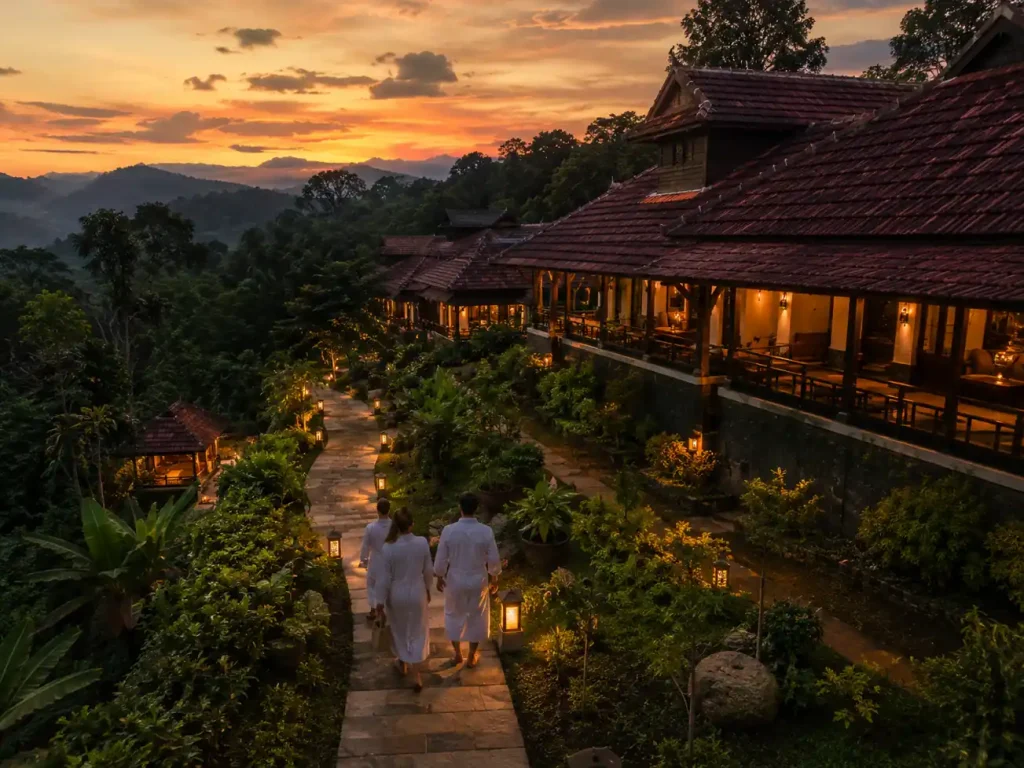
Key confirmed features relevant to international guests:
Yes. Kerala consistently ranks among India’s safest states for international tourists. Residential retreat settings like Tigris Valley provide a completely managed environment — accommodation, meals, therapy, and security are all on-site. Many international guests travel solo specifically because the structured retreat format means they are never navigating unfamiliar environments alone.
Classical Ayurvedic texts identify the monsoon season (June–August) as the optimal therapeutic window. However, Kerala’s climate supports effective Panchakarma year-round. Many international guests prefer the cooler months of October through February for travel comfort and outdoor activities.
Tigris Valley’s Nearby Escapes program provides guided access to Wayanad’s remarkable natural and cultural attractions — waterfalls, wildlife sanctuaries, tribal heritage sites, and spice plantations — compatible with the rest days within your program.
Most nationalities can apply for India’s e-Tourist Visa online. Citizens of most EU countries, the UK, USA, and Gulf Cooperation Council states are eligible. Tigris Valley’s reservations team can provide invitation letter documentation to support visa applications when required.
The full clinical Panchakarma protocol — including Basti and Virechanam — is available only in India due to regulatory restrictions elsewhere. In Kerala, it is practiced in its most authentic, clinically rigorous form with physician supervision and in-house medicated preparations.
Tigris Valley offers a full range of specialised wellness programs including Chronic Pain & Inflammation Management, Cardio-Metabolic Health & Recovery, Cancer Support & Palliative Care, Metabolic Disorder Management, and Corporate Wellness Retreats. See all programs here.
Panchakarma is adapted to the individual — it is not a one-size protocol. Tigris Valley’s physician team conducts a thorough pre-program assessment to identify contraindications, modify procedures as needed, and design a program appropriate for your age, constitution, and health status.
Yes. Tigris Valley’s range of programs means family members with different health goals can be in residence simultaneously, each following their own personalised therapeutic protocol. The shared facilities — gym, yoga room, swimming pools, walking tracks, Ruhe Café — provide spaces for relaxation and connection between sessions.
The nearest major airport is Calicut (Kozhikode) International Airport, with direct flights from Dubai, Abu Dhabi, Riyadh, Dammam, Jeddah, Muscat, Bahrain, and Doha. Full journey details are on the Getting to Tigris Valley page.
For peak months (October–March), booking 6–8 weeks in advance is recommended to allow adequate time for travel arrangements and the pre-arrival medical consultation. Contact the team at Tigris Valley’s contact page or at reservation@tigrisvalley.com to begin the process.
Plan Your Kerala Panchakarma Journey at Tigris Valley
South Asia’s largest AYUSH-integrated, NABH-accredited wellness hospital is ready to design your personalised program. Arabic language support available. Direct flights from the Gulf.